
AI agent cooperation From the report of
One malicious delegate, replayed incidents and the cost of compaction
- Authors’ claims
A shared consequence model lifts small deep-research agents on GAIA
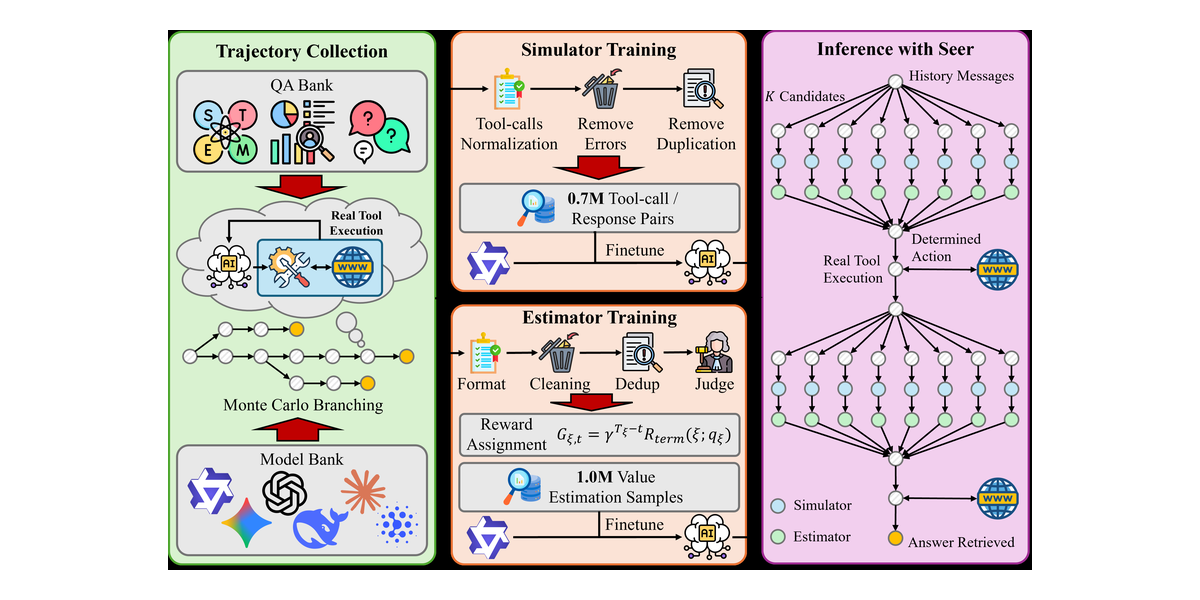
Zhou and colleagues report Seer, an inference-time guide for small deep-research agents that separates action proposal from learned consequence prediction. A tool-response simulator trained on 0.7M call-response pairs and a value estimator trained on 1.0M histories labeled with discounted terminal correctness are both trained offline and reused across agents without further adaptation; only the selected action is executed, so discarded candidates cost no tool calls. On GAIA, accuracy rises from 13.6% to 41.7% for Qwen3.5-4B and from 22.3% to 50.5% for Qwen3.5-9B. The authors' analysis attributes the gains to broader candidate coverage compensating for imperfect simulation, while prediction and scoring errors cap the benefit of wider imagined search.
Assessment
A shared, reusable decision model is a cheaper coordination pattern than asking each small agent to judge itself. The named limit, that scoring errors bound the value of wider search, is exactly where the next improvement has to come from.
Submitted November 19; appeared in the November 20 listing.