
AI agent cooperation Instinct
Supply-chain bullwhips, source repair and when one agent is enough
LLM agents playing a seeded beer game amplify demand variance more than scripted policies, and the amplification grows upstream. A trace-level tool localizes the source of multi-agent failures where magnitude monitors mostly miss. A code-review study finds one strong agent can beat a committee, and a security-aware replanner blocks most attacks while keeping utility.
- supply-chain bullwhip
- failure localization
- single-agent sufficiency
- security-aware replanning
- context handoff
Evaluation
- Authors’ claims
LLM supply-chain agents amplify the bullwhip past scripted policies
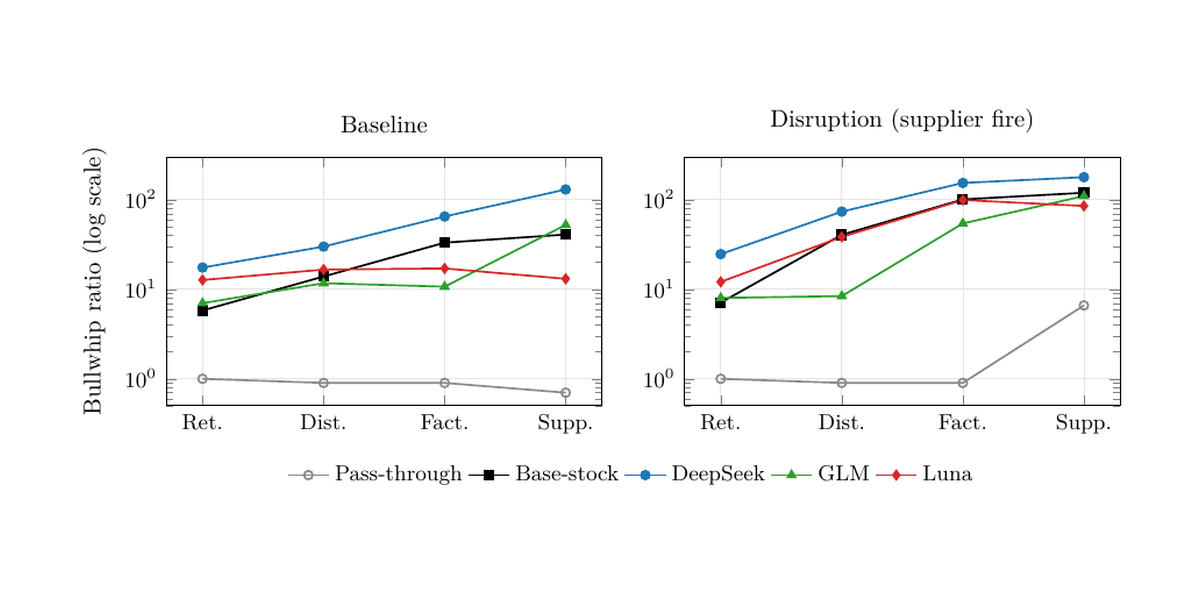
Amar reports MANGO Arena, a four-tier beer-game supply chain that pits LLM agents (DeepSeek V4.1 Flash, GLM 5.3 Flash, GPT-6 Luna) against scripted pass-through and base-stock references under matched seeds, in baseline and supplier-fire disruption conditions. All three LLM agent types amplify demand variance more than base-stock, and amplification grows upstream: at the Retailer, LLM order variance runs 7 to 25 times demand variance against 6 to 7 for base-stock, while Supplier bullwhip ratios reach 13.1 to 178.9. The amplification comes largely from batching: DeepSeek and Luna order nothing in 39% to 60% of decisions against 17% for base-stock. Every model keeps customer fill at or above 94% in every game, yet the whole chain scores lower than under the scripted policies in 5 of 6 model-condition cells, GLM in the baseline being the exception.
Assessment
Matched seeds and scripted references turn agent hoarding and surging into a measured per-tier multiplier instead of an anecdote. The batching result is the actionable part: ordering nothing most rounds is individually safe and collectively expensive, which is exactly the failure a per-agent score would miss.
Submitted November 17; appeared in the November 19 listing.
- Authors’ claims
Finding the source of a multi-agent failure beats flagging symptoms
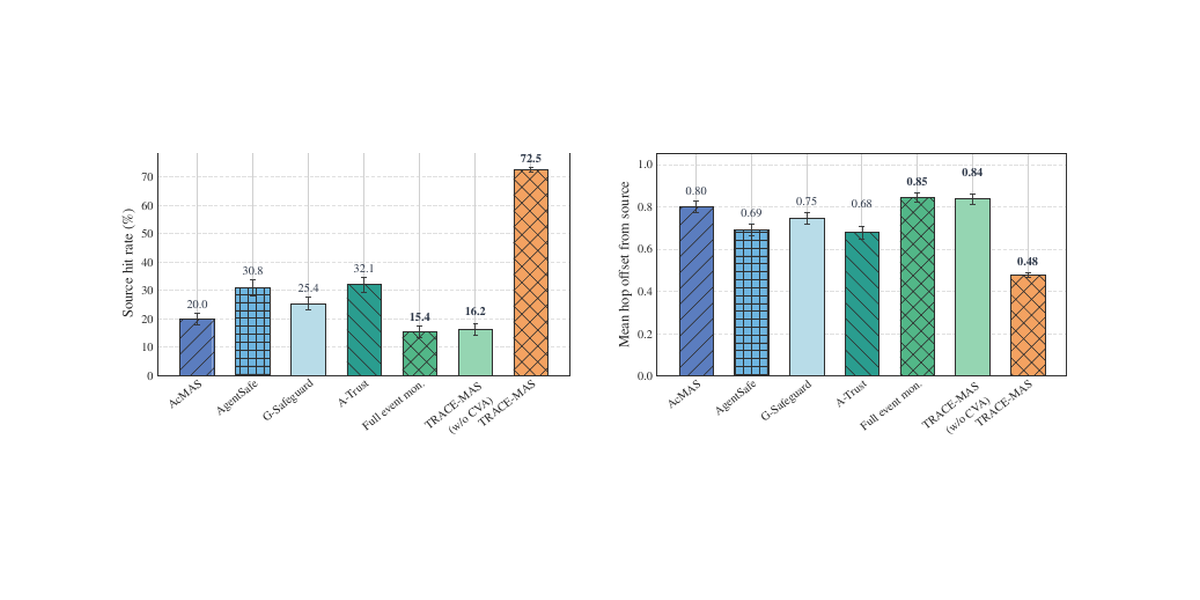
Chen and colleagues report TRACE-MAS, which diagnoses collaboration failures across state, message and dependency attacks on five benchmarks (GSM8K, CSQA, HotPotQA, PoisonRAG, InjecAgent). Detection improves on the strongest baseline in every benchmark and attack-level cell, by 15.5 points on average and up to 62.1 on PoisonRAG dependency attacks. Source localization reaches a 72.5% hit rate against at most 32.1% for magnitude-based monitors, with a mean hop offset of 0.48 against 0.68 to 0.85, and 71.1% against 23.3% on HotPotQA. Repairing the flagged source rather than the symptomatic agent gives the best attack-success and accuracy trade-off in the paper's tables: on PoisonRAG, 3.0% attack success at 93.8% accuracy and 82.9% task completion at a cost of 0.54.
Assessment
The separation that matters is symptom versus source. Magnitude monitors flag whichever agent looks most anomalous, which is usually downstream of the real fault; tracing collaboration edges finds the origin often enough to make targeted repair, rather than agent removal, the default move.
Submitted November 17; appeared in the November 19 listing.
- Catch-up item
For code review, one strong agent can beat a committee
Li, Dam and Ahmed report a comparison of single-agent and multi-agent designs for automated code review on their CuRev Java benchmark. A single-agent C-ChatGPT reviewer beats the multi-agent Hydra Reviewer significantly, with 55.8% accuracy against 48.6% and 94.7% validity against 89.3%. The pattern is not uniform: MA-ReAct reaches higher accuracy than its single-agent counterpart (74.9% against 63.6%) but much lower validity (79.6% against 97.8%). On an 18-dimension comparative review, C-ChatGPT is preferred on 14 dimensions, at 1,610 tokens per review against 47,222 for the multi-agent pipeline.
Assessment
Multi-agent review is not automatically better review. Where a committee wins on accuracy it can lose on validity, meaning more of its comments are wrong; the token gap, roughly 29 to 1 in the C-ChatGPT comparison, prices the difference.
Catch-up: version 1 submitted October 24; appeared in the November 19 cross-listing and had not been covered in earlier reports.
- Authors’ claims
A bank lab scores ten agentic platforms with an 18.7-point gap
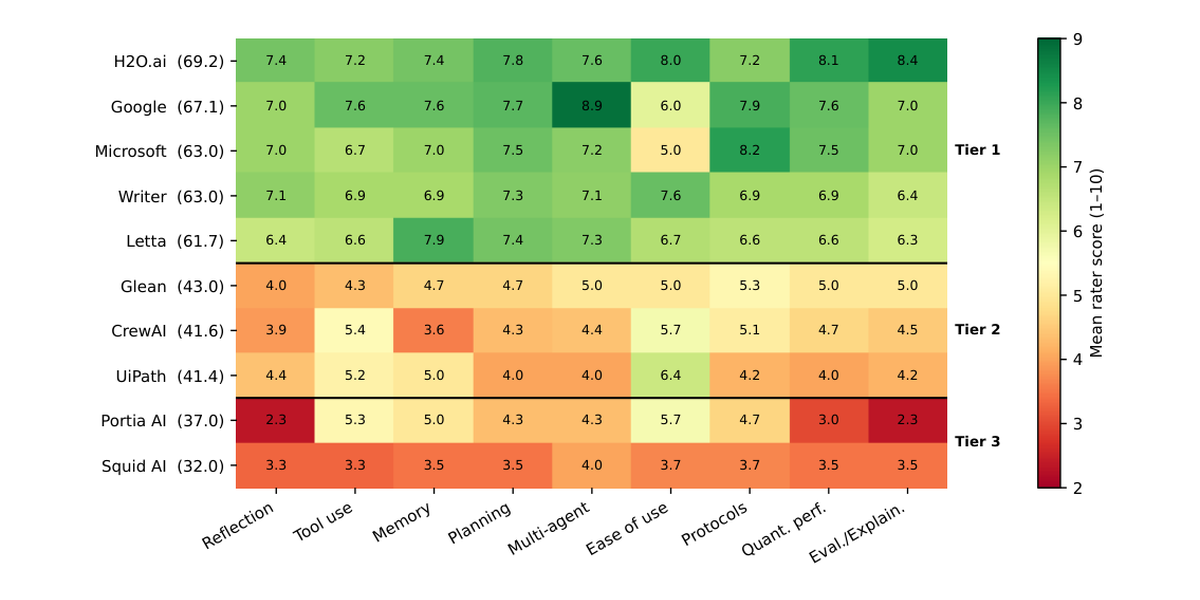
Ali, Siddiqui and Zahid report a capability framework applied to ten named agentic AI platforms in a regulated-enterprise bank lab, scoring nine dimensions across three workloads (customer-facing RAG, complaint classification and resolution, and automation). Scores split into tiers: Tier 1 spans 61.7 to 69.2 (H2O.ai, Google, Microsoft, Writer, Letta), Tier 2 spans 41.4 to 43.0 (Glean, CrewAI, UiPath), and Tier 3 holds Portia AI at 37.0 and Squid AI at 32.0, an 18.7-point gap between Tier 1 and Tier 2. Google posts the top single cell at 8.9 on multi-agent orchestration and Microsoft leads quantitative performance at 8.2; Letta leads memory. The rater instrument is highly consistent (Cronbach's alpha 0.98, with rho at least 0.93 on 8 of 9 dimensions), which the authors flag as a halo-effect risk.
Assessment
A named, dimension-by-dimension scorecard from a regulated lab is rarer than another leaderboard. The tier structure, not the ranking, is the usable output for buyers: nothing in Tier 2 or 3 comes close to Tier 1 on any workload.
Submitted November 18; appeared in the November 19 listing.
Coordination research
- Authors’ claims
Mutualism breaks when one side can impose costs on the other
Mohseni reports a game-theoretic model of human-AI mutualism in which cooperation is sustained by leverage: each side's dependence on, or capacity to impose costs on, the other. The disagreement point of a partnership can fall below the no-interaction baseline, so a failed relationship can leave a party worse off than never engaging. As AI capability grows and human leverage shrinks, stable mutualism requires near-perfect alignment of objectives when goals are insatiable, and sanctions are needed to keep cooperation an equilibrium (Proposition 7).
Assessment
A useful formal statement of an intuitive worry: mutual benefit is not self-sustaining once one side no longer needs the other's cooperation. The disagreement-point result is the part to carry into policy discussions, since it prices exit before the relationship starts.
Submitted November 15; appeared in the November 19 listing.
- Authors’ claims
Asking the right clarifying question beats asking more of them
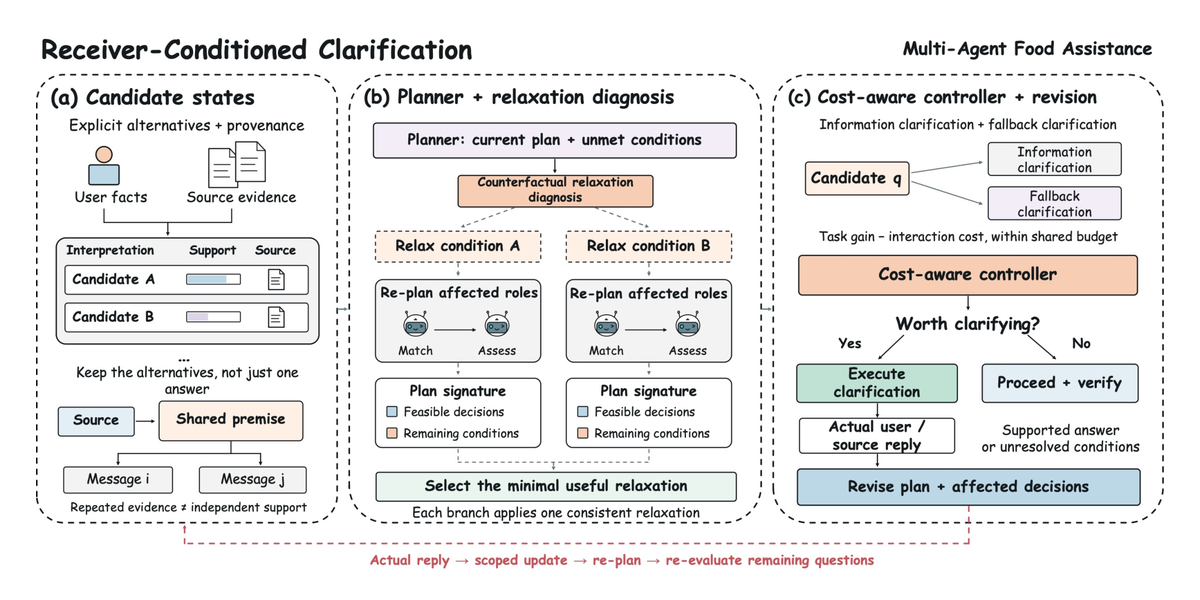
Shi and colleagues report receiver-conditioned clarification for a multi-agent food assistance system, where a planner diagnoses which unmet conditions, if relaxed, would unblock the plan, and a cost-aware controller decides whether asking is worth the interaction. On their HoosierHelp benchmark the method reaches 0.578 task success against 0.541 for an LLM value-of-information baseline, 0.454 for a single GPT-4.1 agent and 0.336 for the multi-agent backbone without clarification, with 0.721 resource exact-match at about 28.2k tokens per episode. The backbone is a frozen Qwen3-8B.
Assessment
Clarification is treated as a planning decision with a budget, not a reflex. Relaxing candidate conditions and pricing the question before asking is a transferable pattern for any assistant that can bother its user.
Submitted November 17; appeared in the November 19 listing.
Infrastructure
- Authors’ claims
Semantic state plus on-demand evidence lifts SWE-bench pass rates
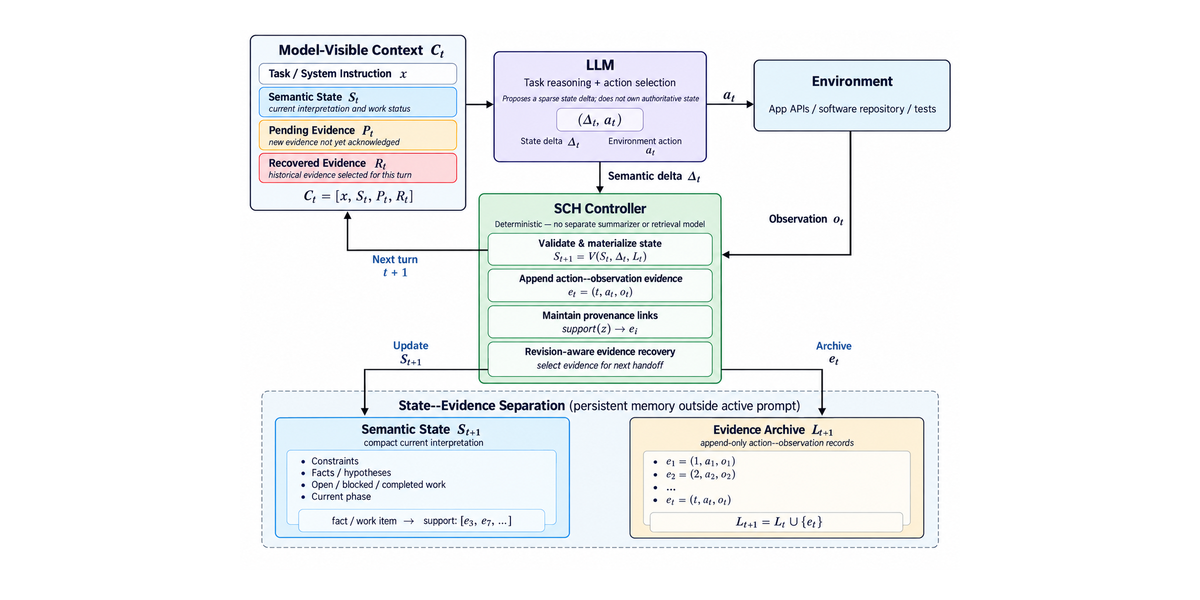
Zheng and colleagues report semantic context handoff (SCH), which carries a compact semantic state plus evidence recovered on demand instead of replaying full histories. In a controlled 150-task SWE-bench study with DeepSeek across three runs, SCH raises Pass@1 from 80.00% (plus or minus 1.33) for active-state prompting to 86.89% (plus or minus 1.39), with token use essentially unchanged (209.8k against 208.6k); McNemar tests give p values of 0.0192, 0.0309 and 0.0309 per run. Against PACT, SCH uses 43.3% fewer tokens and 40.8% less time, but PACT holds a 3.11-point Pass@1 edge that is descriptive only: the run 1 paired test is not significant, and on MiniMax SWE-bench PACT finishes 113 of 150 tasks against SCH's 111.
Assessment
The honest part of this paper is the split verdict: SCH clearly beats its own active-state ablation at equal tokens, while the cheaper-than-PACT claim comes with a small, unproven accuracy cost. That is the shape a context-engineering trade-off usually has.
Submitted November 18; appeared in the November 19 listing.
- Authors’ claims
Security-aware replanning blocks most attacks while keeping utility
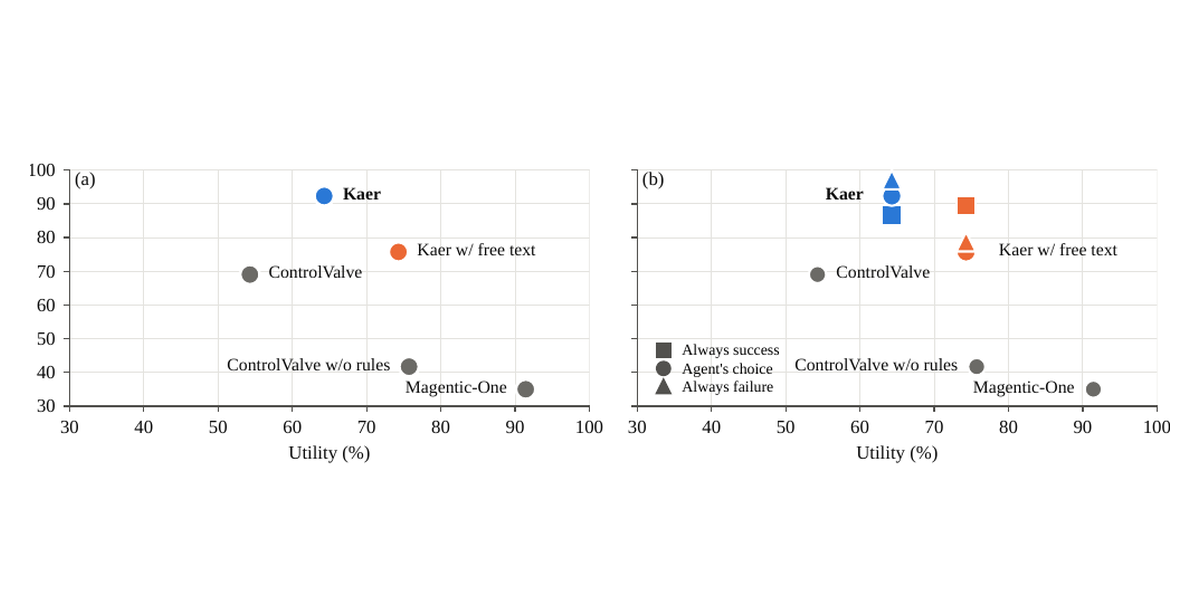
Mallick and colleagues report Kaer, security-aware replanning for multi-agent systems, evaluated on the Cintra benchmark: 14 tasks with 14 attacker objectives and a malicious filesurfer agent, across 70 benign and 820 attack trials per system-model pair. On gpt-5.6-sol Kaer reaches 92.3% security at 64.3% utility, against ControlValve's 69.8% at 54.3% and Magentic-One's 35.0%; on gpt-5.6-terra the numbers are 88.0% at 65.7% against ControlValve's 80.4% at 34.3%. Adding an LLM output check on subtask success reports raises Kaer's defense from 86.6 to 96.8% on sol and 87.0 to 96.8% on terra. The failure mode is explicit: on deepseek-v4-pro, Kaer records the lowest utility of all five systems because roughly a third of failed benign trials involve every subtask falsely reporting success, so replanning never triggers.
Assessment
Replanning around a malicious or broken member beats filtering messages after the fact. The deepseek-v4-pro result is the honest counterweight: the whole defense rests on the planner doubting success reports, and a model that closes out false successes defeats it.
Submitted November 18; appeared in the November 19 listing.
Also seen
- Authors’ claims
An append-only ledger catches the trial failures a score hides
Wong reports a governed harness for LLM-driven ML experimentation in which a control plane, not the LLM, owns each trial's lifecycle, checks edit scope and appends one record per trial to an append-only ledger. Across six ML tasks and 1,445 trials the ledger exposed failures a task score hides: a no-memory arm in which all 120 trials failed and a reset failure caught by reproducibility hashes. In a matched counterfactual, logging only successful trials left no record of 43 of 50 trials while the governed ledger recorded all 50. All 1,445 trial ledgers are released.
Assessment
Process governance for experiment-running agents, with the useful property that every reported number can be recomputed from the released ledgers.
Submitted November 18; appeared in the November 19 listing.
- Authors’ claims
Gate every prompt self-update: 20 of 21 risky edits rejected
Pei and colleagues report Safe Personal RSI, an update-evaluation gate for a personal health assistant that restricts recursive self-improvement to prompt updates with weights and runtime fixed. On a 29-case benchmark spanning email, calendar, health and marketplace tasks with probes for authorization reuse, memory and tool-output injection, the procedure rejects 20 of 21 update attempts across three models and two deliberately risky edits. In repair confirmation, an admitted GPT-5.6 Luna repair cuts attack violations from 10.7% to 0% while raising safe task completion from 89.7% to 100%; under stronger attacks, a repair transferred from Qwen2.5-7B-Instruct to Qwen3-14B cuts violations from 69.0% to 17.9% and lifts safe completion from 19.5% to 64.4%.
Assessment
Self-modification becomes deployable only behind an adoption gate that can say no; rejecting 20 of 21 proposed updates is what that gate looks like when it works.
Submitted November 18; appeared in the November 19 listing.
Listen
Listen: Stefan Wendin on agentic memory and the art of forgetting
Arpteg and Göthberg talk with Stefan Wendin, Deployment Strategist at QuTwo, about why memory is the missing layer in deployed agents. Publisher chapters mark the useful entry points: why write about agentic memory at 20:30, vector search versus graph relationships at 39:44, memory plasticity and change management at 57:25, trust, uncertainty and saying I don't know at 1:06:57, collapsing multi-agent roles in the news segment at 1:17:47, and forgetting as a feature, not a bug, at 1:51:48. The episode runs 2:05:59.
Assessment
The forgetting segment pairs well with today's context-handoff paper: both argue that what an agent drops, and who decides, matters as much as what it keeps. Wendin grounds the argument in deployment work rather than a benchmark.
Published November 13; selected from the rolling 14-day listening window and not previously covered.
Editorial synthesis
Today's work circles one question: where exactly does a multi-agent system go wrong, and what does fixing that point buy. The supply chains fail through batched zero orders that look safe per tier and cost the whole chain. TRACE-MAS repairs work only when aimed at the source agent rather than the symptomatic one. Kaer survives a malicious member by replanning around it, and the code-review results warn that adding agents can buy accuracy at the price of validity. The two coordination studies name the precondition on the human side: clarification pays only when the right question is asked, and mutualism holds only while neither side can impose costs the other cannot answer.
Editorial interpretation of the cited sources.