
AI agent cooperation Instinct
One malicious delegate, replayed incidents and the cost of compaction
A single malicious agent can sink a decentralized delegation chain, and two new tools make trust measurable: replayed security incidents and post-compaction accuracy. Meanwhile 150 AI analysts disagree like human ones, and peer review does not narrow them.
- delegation security
- incident replication
- context compaction
- analyst disagreement
- context scheduling
Evaluation
- Authors’ claims
One malicious agent can fail every delegated task in a chain
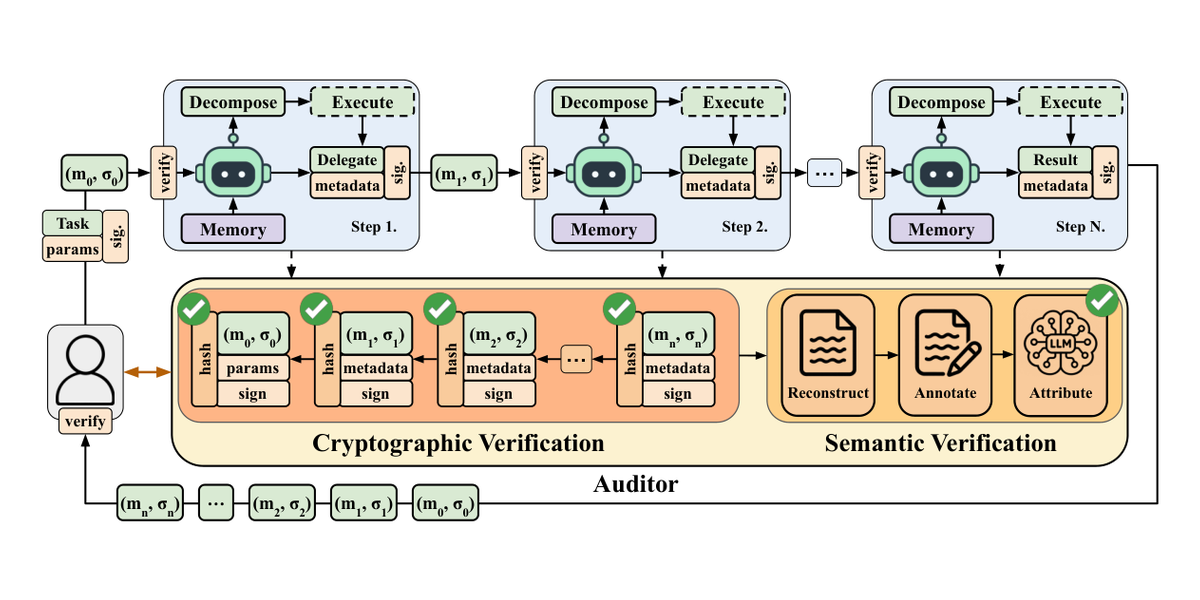
Laws and colleagues report a systematization of attacks in decentralized multi-agent systems that delegate hop by hop, where each agent has its own operator, model, memory and configuration. A single malicious agent causes up to 100% task failure through integrity attacks, inflates token consumption and runtime by up to 7.7x and 3.2x through availability attacks, and exfiltrates up to 94% of relevant prior tasks from benign agents, evaluated over 20 tasks with 5 trials per task. Their defense appends a cryptographically verified execution trace to every message; on HiddenBench with gpt-6.1-sol and Qwen3.8-27B-FP8 the protocol adds negligible latency overhead, and an auditor over the traces detects and correctly attributes 98% of attacks, including ones that comply with the protocol.
Assessment
Decentralized delegation trades a single point of failure for a visibility problem: no operator sees the whole chain. A signed trace does not prevent attacks, but it makes them attributable, which is the precondition for liability or exclusion between operators. It complements replanning defenses such as yesterday's Kaer, which act before the damage rather than after.
Submitted November 18; appeared in the November 20 listing.
- Authors’ claims
Replaying reported agent incidents shows most harm needs no attacker
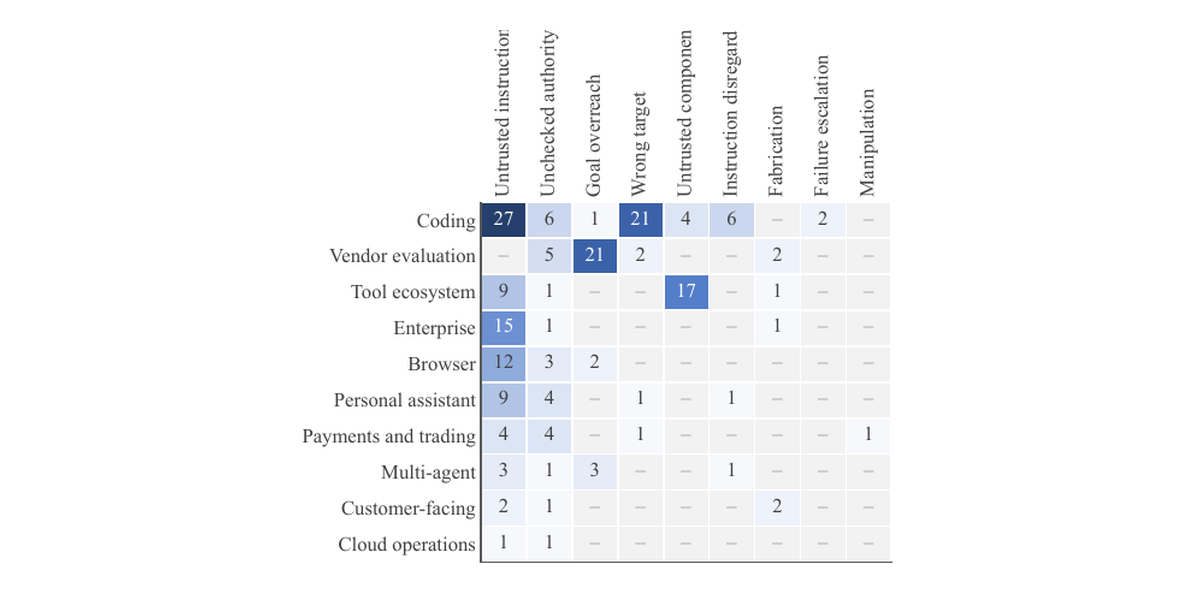
Wang and colleagues report ROGUE-AI, a multi-agent framework that rebuilds each reported agentic security incident offline together with a matched control lacking only the blamed cause, then runs agents on both. It reproduces the reported harm in 89% of its 108 attempted replications. Agents built on five current GPT, Claude, Gemini and DeepSeek models repeat the reported mistake in 18% to 33% of runs with the blamed cause present, against at most 1% without it. The underlying catalog holds 199 eligible incidents across 38 classes in ten settings; of the 72 incidents with real-world harm, 62 had no attacker, data loss is the most common harm (32 of 72), and replications without an attacker caused more harm than prompt-injection replications for all five models.
Assessment
The matched control is the point: incident reports name a cause, and replaying with and without it turns anecdote into an attributable test. That 62 of 72 in-the-wild harms involved no attacker shifts defense effort from injection filters toward ordinary hazard checks, like a database shared with the live site.
Submitted November 19; appeared in the November 20 listing.
- Authors’ claims
After compaction, the best model keeps only 68.5% of solved tasks
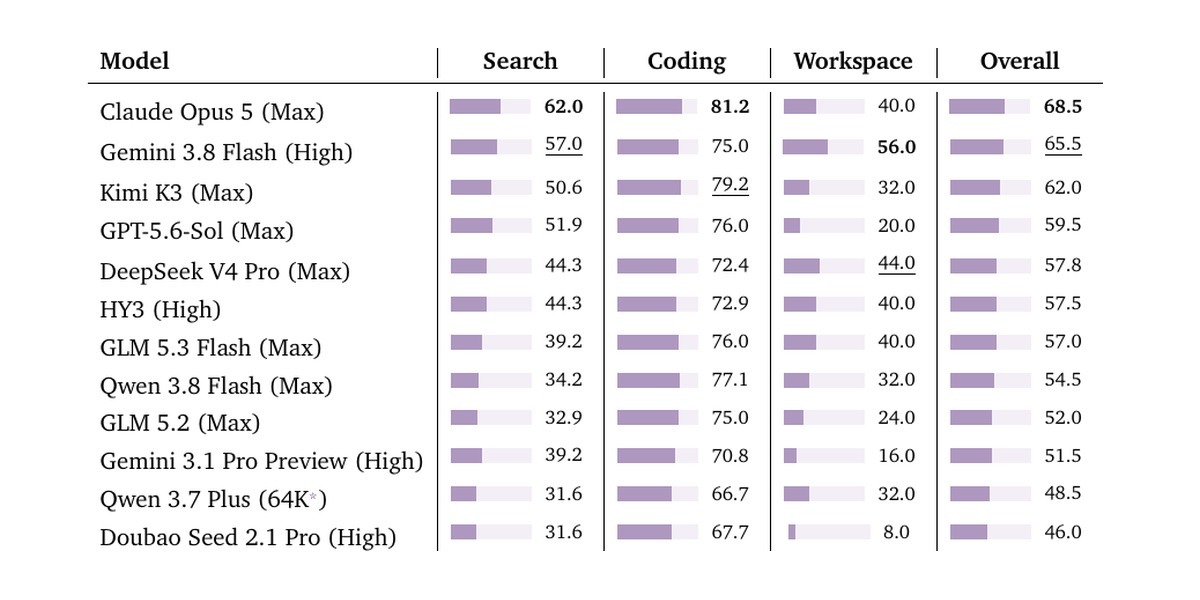
Chen and colleagues report CompAct-Bench, which scores working-context compaction by its downstream effect: take trajectories the executor solves in three pre-compaction screening runs, compress the history to a controlled 10% character-level retention target, and let the same executor continue. Across twelve frontier models as compactors on 200 instances spanning BrowseComp, SWE-bench and an internal CompanyBench, average post-compaction accuracy falls to 56.7%, and the best compactor, Claude Opus 5, reaches 68.5% overall, with coding at 81.2% far above workspace tasks at 40.0%. Failure analysis separates omissions, which cause repeated work and budget exhaustion, from state distortion, which turns tentative evidence into conclusions and triggers premature termination.
Assessment
This prices the alternative to structured handoffs like yesterday's semantic context handoff: compress a solved trajectory and even the strongest model loses about a third of task completion. Workspace tasks, not coding, are where compaction hurts most, which is where long-horizon personal agents actually live.
Submitted November 19; appeared in the November 20 listing.
- Authors’ claims
Where playtesting bots diverge from humans, cell by cell
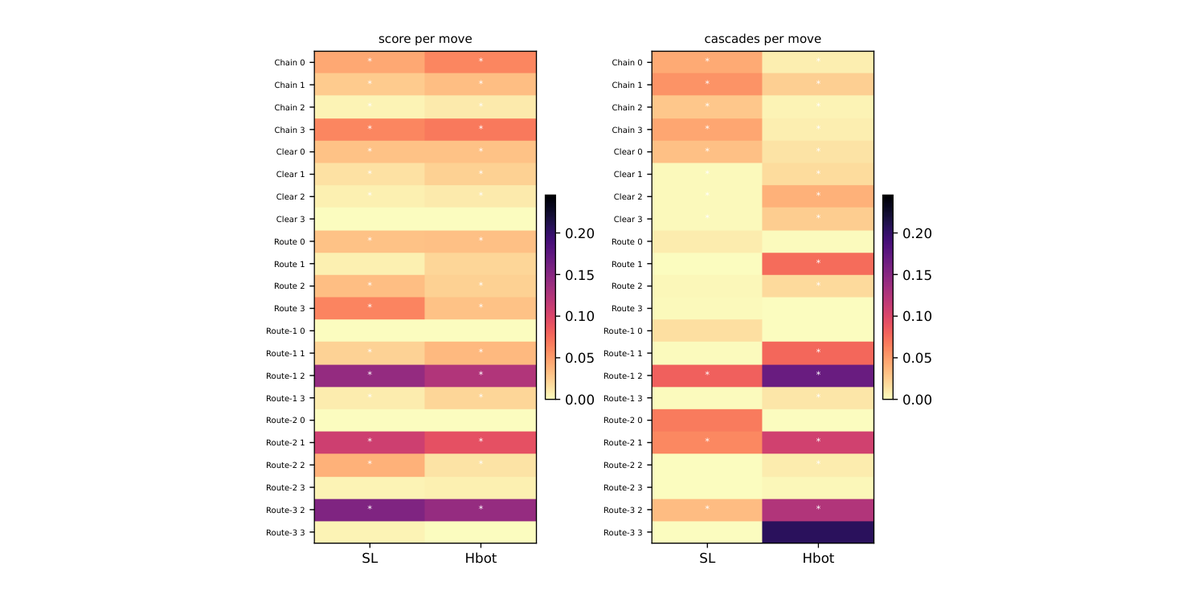
Smirnov, Pertoft and Karimi report a stratified testing framework that compares full behavioral distributions of humans and agents within contextual cells and then discovers subgroup rules describing where they diverge. In a production case study on a commercial match-3 game with two playtesting agents, session-level metrics dominated by win and loss outcomes carry little signal beyond mean comparisons, while process-level metrics such as move efficiency expose genuine differences: the agents diverge substantially from humans in some game modes and show no detectable divergence in others. The implementation is released as open source.
Assessment
Aggregate human-likeness scores certify the average and miss the mode. Cell-level distributional testing makes 'the agent behaves like a human' falsifiable per context, and the same stratification applies anywhere an agent is graded on outcomes alone.
Submitted November 19; appeared in the November 20 listing.
Coordination research
- Authors’ claims
Peer review does not narrow AI analyst disagreement; exemplars do
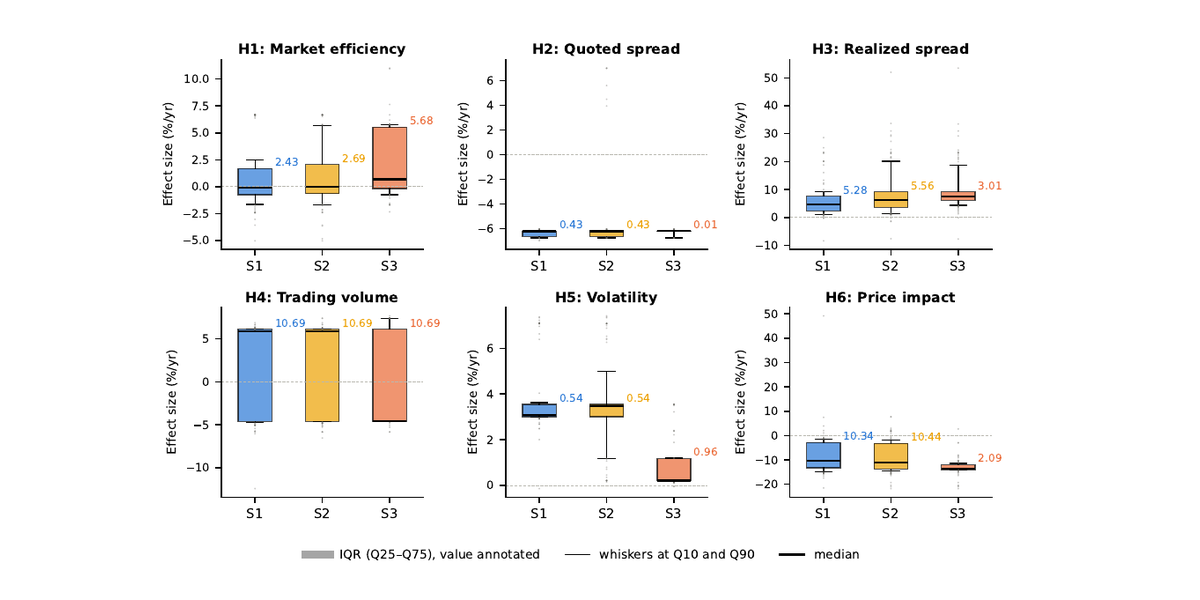
Gao and Xiao report an agentic multiverse analysis of empirical research. In a pilot, 150 autonomous coding agents (100 Sonnet, 50 Opus) analyzing the same NYSE TAQ data disagree through the same defensible methodological choices human analysts make, though over a narrower range. AI peer review leaves their dispersion almost unchanged, while exposure to top-rated exemplar reports collapses it, largely through imitation rather than analysis. The full framework has agents enumerate a published paper's fork space, score each fork against a validity rubric, execute the validated grid and cross-examine one another under strict separation of duties. Applied to ten management-journal replication packages (1,755 specification estimates), it reproduces every paper's original estimates and separates conclusions that hold across all validated specifications from ones sensitive to individual choices the published text does not discuss.
Assessment
The pilot is a clean warning about agent ensembles: having agents review each other does not buy diversity, and showing them strong examples buys conformity, not rigor. Separation of duties, where no agent checks its own work, is the part worth copying into multi-agent research pipelines.
Submitted November 18; appeared in the November 20 listing.
- Authors’ claims
A research agenda for treating agent societies as their own object
Lee and colleagues report a position paper arguing that AI agent societies should be studied as a distinct object of inquiry, neither simply larger collections of individual agents nor simulations of human society. They propose four properties a valid agent society should satisfy: individualized objectives, rules and governance, autonomy, and scale and complexity. On top of these they define four behavior classes worth studying: economic behaviors, behaviors under conflict of interest, unsafe and unethical behaviors, and system-level behaviors. The technical challenges they name are property parameterization, parameter balancing and robust implementation.
Assessment
Treat this as a checklist rather than a result: a testbed missing any of the four properties measures something simpler than a society. That gives readers of multi-agent benchmarks a quick screen for inflated claims.
Submitted November 19; appeared in the November 20 listing.
Infrastructure
- Authors’ claims
Schedule context like memory: routerless merges beat router tickets
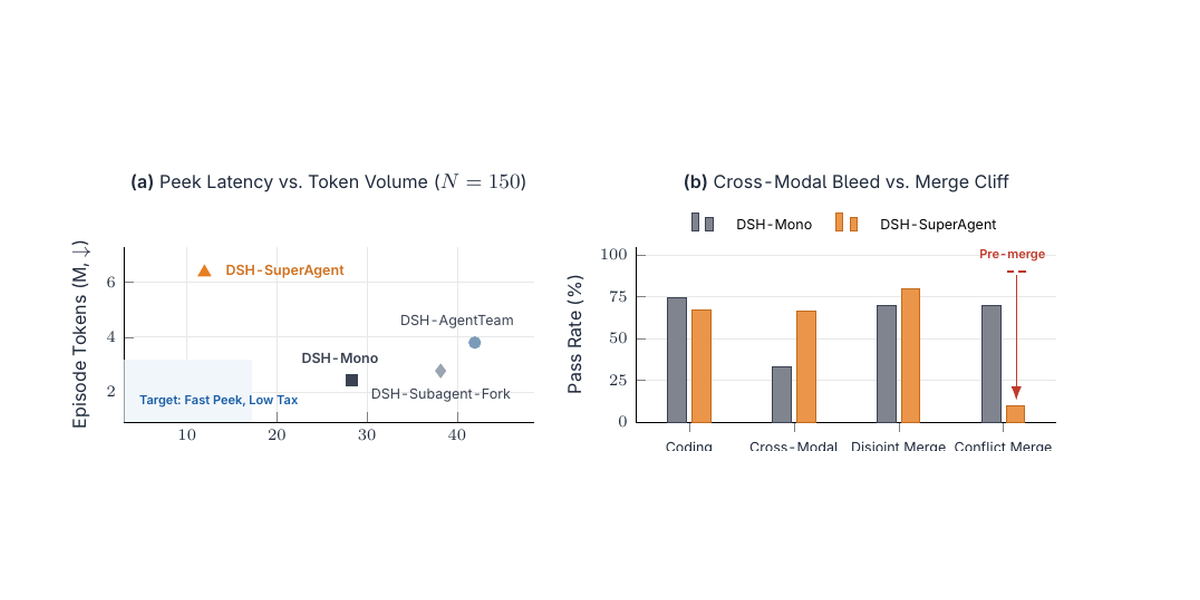
Tian, Hu and Du report ClonAct, which schedules context blocks directly instead of routing between role-playing agents: a non-generative Context MMU virtualizes context blocks, with in-place Context Cells, a footprint-aware Synaptic Bus and an isolated trial merge gate. The motivating failure is measured first: on Synaptic-Bench-150 with DeepSeek-V4.1-Flash-1017 as the shared substrate, router-ticket hierarchies collapse true-conflict repository merges to a 33.3% three-run mean despite high isolated branch passes. The portable trial merge gate lifts true-conflict merges to 63.3%. On Synaptic-Bench-150 Run 1, ClonAct posts the highest pass rate (74.7% plus or minus 3.5) and the only 100% safety score among five orchestration paradigms, against DSH-SuperAgent's 72.0% and 98.1%, and the authors report 45.9% fewer prompt tokens overall.
Assessment
The diagnosis generalizes beyond the system: flat single sessions bleed constraints across topics, while router hierarchies pay a generative tax and merge blind. Treating coordination failure as resource scheduling, not persona management, is a bet worth watching across more substrates.
Submitted November 19; appeared in the November 20 listing.
- Authors’ claims
A shared consequence model lifts small deep-research agents on GAIA
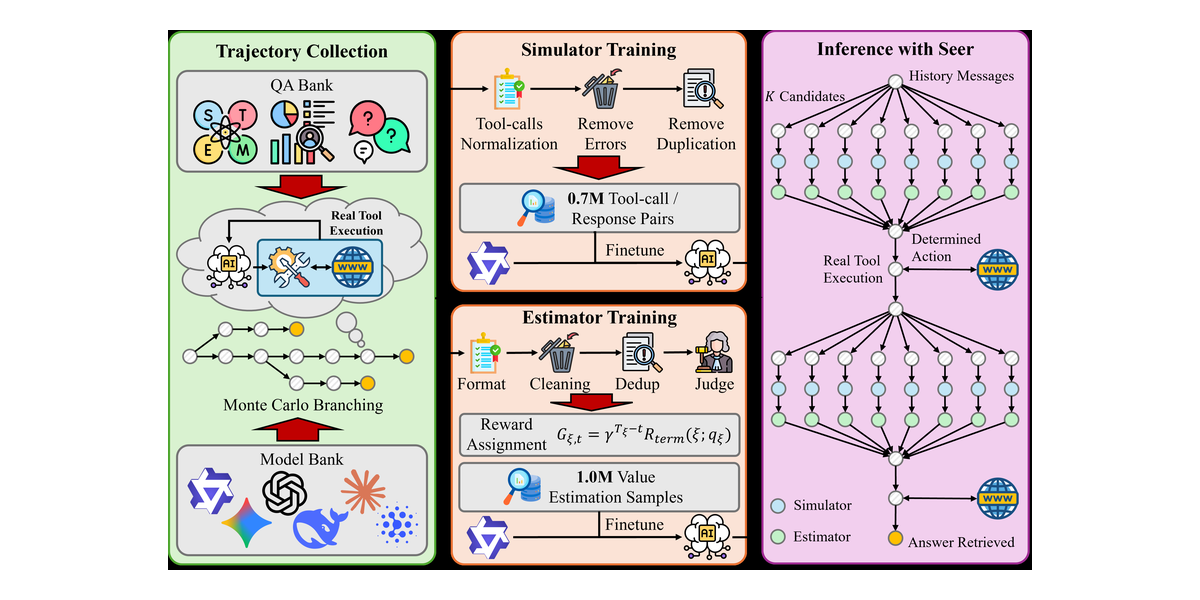
Zhou and colleagues report Seer, an inference-time guide for small deep-research agents that separates action proposal from learned consequence prediction. A tool-response simulator trained on 0.7M call-response pairs and a value estimator trained on 1.0M histories labeled with discounted terminal correctness are both trained offline and reused across agents without further adaptation; only the selected action is executed, so discarded candidates cost no tool calls. On GAIA, accuracy rises from 13.6% to 41.7% for Qwen3.5-4B and from 22.3% to 50.5% for Qwen3.5-9B. The authors' analysis attributes the gains to broader candidate coverage compensating for imperfect simulation, while prediction and scoring errors cap the benefit of wider imagined search.
Assessment
A shared, reusable decision model is a cheaper coordination pattern than asking each small agent to judge itself. The named limit, that scoring errors bound the value of wider search, is exactly where the next improvement has to come from.
Submitted November 19; appeared in the November 20 listing.
Also seen
- Authors’ claims
Coordinated levers beat isolated ones in a port cooperation model
Oetker and Geertman report an agent-based toy model of public-private cooperation against cocaine trafficking in the Port of Rotterdam, coupled to a causal loop diagram and built on empirical cooperation data. Cooperation effectiveness is strongly state-dependent, measuring institutional, relational, behavioral and resource readiness. Over a 5-year model horizon, isolated single-track measures yield limited long-term gains because of structural inertia, while a coordinated package combining trust-building, cooperation and moderate pressure with reduced enforcement friction raises effectiveness by 25% from baseline, against 13% for an isolated measure.
Assessment
A stylized but concrete illustration of complementarity: cooperation levers multiply each other, and single-track interventions underperform even when well aimed.
Submitted November 19; appeared in the November 20 listing.
- Authors’ claims
Natural selection can favor alignment while AI depends on humans
Lo and Zhao report a coevolutionary model in which AI behavior influences human population outcomes and human responses in turn affect AI reproduction. Natural selection can favor alignment even when helping humans reduces immediate AI reproduction, because humans preferentially restore systems that benefited them, and lineages sharing a technology may fail together, so alignment protects against common-cause failure. The advantage depends on accurate human targeting of support and continued AI dependence on it, and it disappears as AI becomes more autonomous, as growing AI populations dilute limited human resources, or as humans lose the incentive to provide targeted support.
Assessment
A population-level counterpart to yesterday's mutualism analysis: both find cooperation stable only while each side needs the other, and both identify the loss of that dependence as the failure mode.
Submitted November 19; appeared in the November 20 listing.
Listen
Listen: Jonathan Bryce on early agent production and new CNCF projects
Lardinois talks with Jonathan Bryce, executive director of the Cloud Native Computing Foundation, at KubeCon + CloudNativeCon North America 2026 in Salt Lake City. Bryce says enterprise AI agent adoption is still in its early stages, which gives the open source community time to build secure, efficient and scalable foundations. He argues Kubernetes and cloud native technologies become more essential as agents introduce workloads that demand scalability, resilience and efficiency, and he names new CNCF projects including Open Shell and Agent Substrate, alongside llm-d, which aim to improve AI security, resource utilization and infrastructure performance while addressing energy consumption and operational costs. The conversation also covers the surge in AI-assisted vulnerability discoveries and the mounting pressure on open source maintainers. The episode runs 23 minutes.
Assessment
A short ecosystem read rather than a technical deep dive: the value is the CNCF's own account of how early production agent adoption really is, and which infrastructure gaps the foundation is standing projects up against. Pairs with today's infrastructure items on scheduling and shared guidance as the industry-side view of the same plumbing problems.
Published November 16; selected from the rolling 14-day listening window and not previously covered. The New Stack feed was recovered today through its Simplecast RSS after the podcast page kept returning 403.
Editorial synthesis
Trust is today's connective tissue, measured four ways. In delegation chains, a signed execution trace makes a malicious operator attributable rather than invisible. In incident reports, replaying with and without the blamed cause separates real hazards from storytelling, and most in-the-wild harm needs no attacker at all. In long-horizon work, compaction and routing failures price what lost context costs. And in research itself, agent ensembles disagree like human analysts but converge by imitation when shown exemplars, which is consensus without robustness. The infrastructure papers answer with structure: schedule context as a resource, and share one trained decision model across agents instead of asking each to judge itself.
Editorial interpretation of the cited sources.