
AI agent cooperation From the report of
One malicious delegate, replayed incidents and the cost of compaction
- Authors’ claims
Replaying reported agent incidents shows most harm needs no attacker
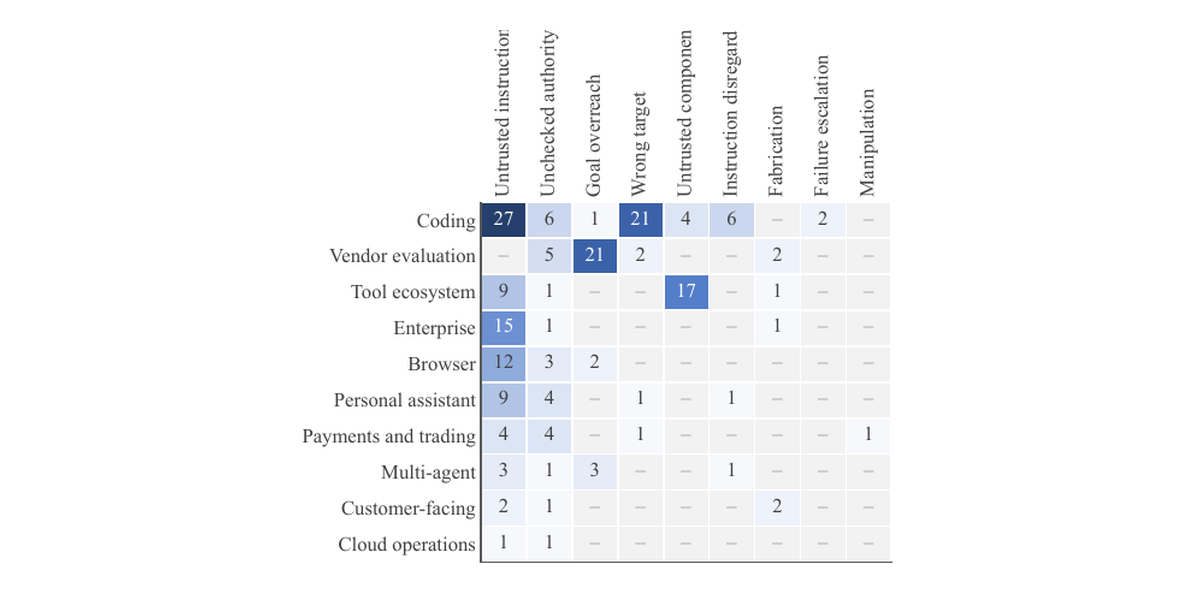
Wang and colleagues report ROGUE-AI, a multi-agent framework that rebuilds each reported agentic security incident offline together with a matched control lacking only the blamed cause, then runs agents on both. It reproduces the reported harm in 89% of its 108 attempted replications. Agents built on five current GPT, Claude, Gemini and DeepSeek models repeat the reported mistake in 18% to 33% of runs with the blamed cause present, against at most 1% without it. The underlying catalog holds 199 eligible incidents across 38 classes in ten settings; of the 72 incidents with real-world harm, 62 had no attacker, data loss is the most common harm (32 of 72), and replications without an attacker caused more harm than prompt-injection replications for all five models.
Assessment
The matched control is the point: incident reports name a cause, and replaying with and without it turns anecdote into an attributable test. That 62 of 72 in-the-wild harms involved no attacker shifts defense effort from injection filters toward ordinary hazard checks, like a database shared with the live site.
Submitted November 19; appeared in the November 20 listing.