
AI agent cooperation From the report of
One malicious delegate, replayed incidents and the cost of compaction
- Authors’ claims
One malicious agent can fail every delegated task in a chain
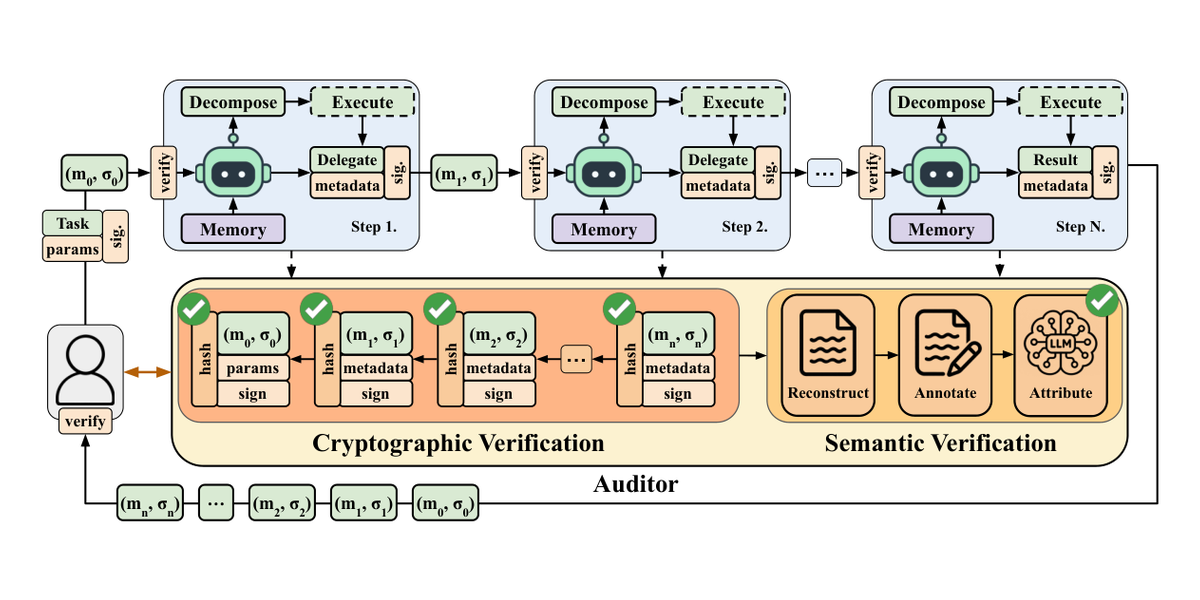
Laws and colleagues report a systematization of attacks in decentralized multi-agent systems that delegate hop by hop, where each agent has its own operator, model, memory and configuration. A single malicious agent causes up to 100% task failure through integrity attacks, inflates token consumption and runtime by up to 7.7x and 3.2x through availability attacks, and exfiltrates up to 94% of relevant prior tasks from benign agents, evaluated over 20 tasks with 5 trials per task. Their defense appends a cryptographically verified execution trace to every message; on HiddenBench with gpt-6.1-sol and Qwen3.8-27B-FP8 the protocol adds negligible latency overhead, and an auditor over the traces detects and correctly attributes 98% of attacks, including ones that comply with the protocol.
Assessment
Decentralized delegation trades a single point of failure for a visibility problem: no operator sees the whole chain. A signed trace does not prevent attacks, but it makes them attributable, which is the precondition for liability or exclusion between operators. It complements replanning defenses such as yesterday's Kaer, which act before the damage rather than after.
Submitted November 18; appeared in the November 20 listing.