
AI agent cooperation From the report of
One malicious delegate, replayed incidents and the cost of compaction
- Authors’ claims
Schedule context like memory: routerless merges beat router tickets
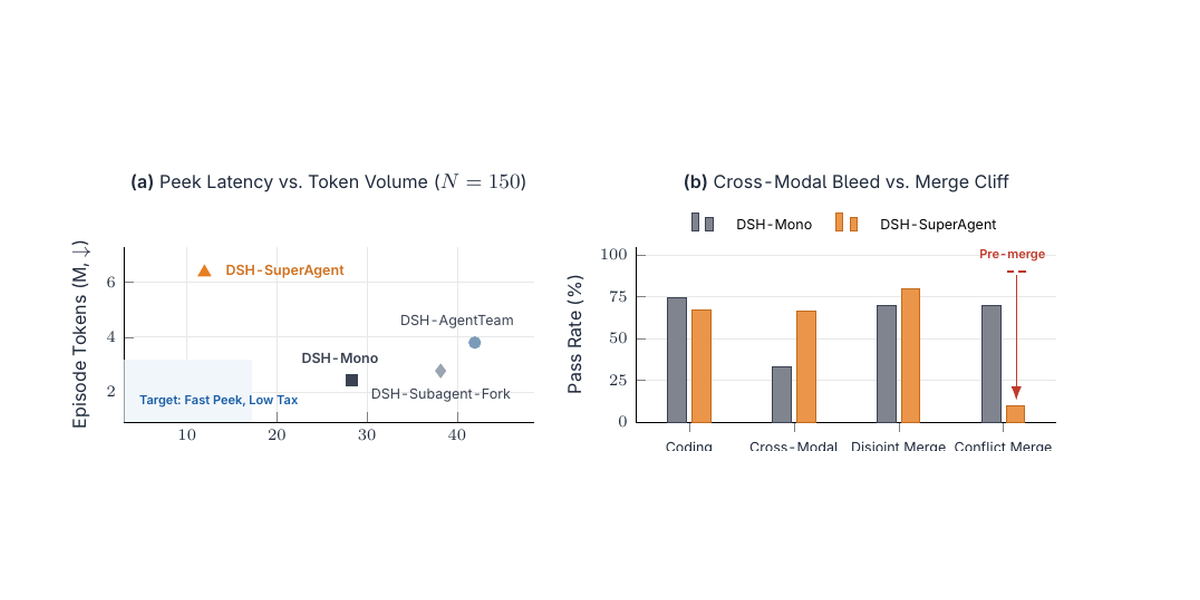
Tian, Hu and Du report ClonAct, which schedules context blocks directly instead of routing between role-playing agents: a non-generative Context MMU virtualizes context blocks, with in-place Context Cells, a footprint-aware Synaptic Bus and an isolated trial merge gate. The motivating failure is measured first: on Synaptic-Bench-150 with DeepSeek-V4.1-Flash-1017 as the shared substrate, router-ticket hierarchies collapse true-conflict repository merges to a 33.3% three-run mean despite high isolated branch passes. The portable trial merge gate lifts true-conflict merges to 63.3%. On Synaptic-Bench-150 Run 1, ClonAct posts the highest pass rate (74.7% plus or minus 3.5) and the only 100% safety score among five orchestration paradigms, against DSH-SuperAgent's 72.0% and 98.1%, and the authors report 45.9% fewer prompt tokens overall.
Assessment
The diagnosis generalizes beyond the system: flat single sessions bleed constraints across topics, while router hierarchies pay a generative tax and merge blind. Treating coordination failure as resource scheduling, not persona management, is a bet worth watching across more substrates.
Submitted November 19; appeared in the November 20 listing.