
AI agent cooperation Instinct
Trade deals that must execute, and agents who ask on demand
TradeWar scores signed deals on executed economic value rather than agreement alone. Ask on Demand learns when peer communication helps, while VerifyMAS diagnoses failures across whole trajectories. Plus structured sub-agent recovery and a catch-up listen on agent-run companies.
- negotiation
- benchmarks
- execution-feedback
- peer-communication
- multi-agent-systems
- failure-attribution
Evaluation
- Authors’ claims
TradeWar scores negotiated deals on executed value, not agreement
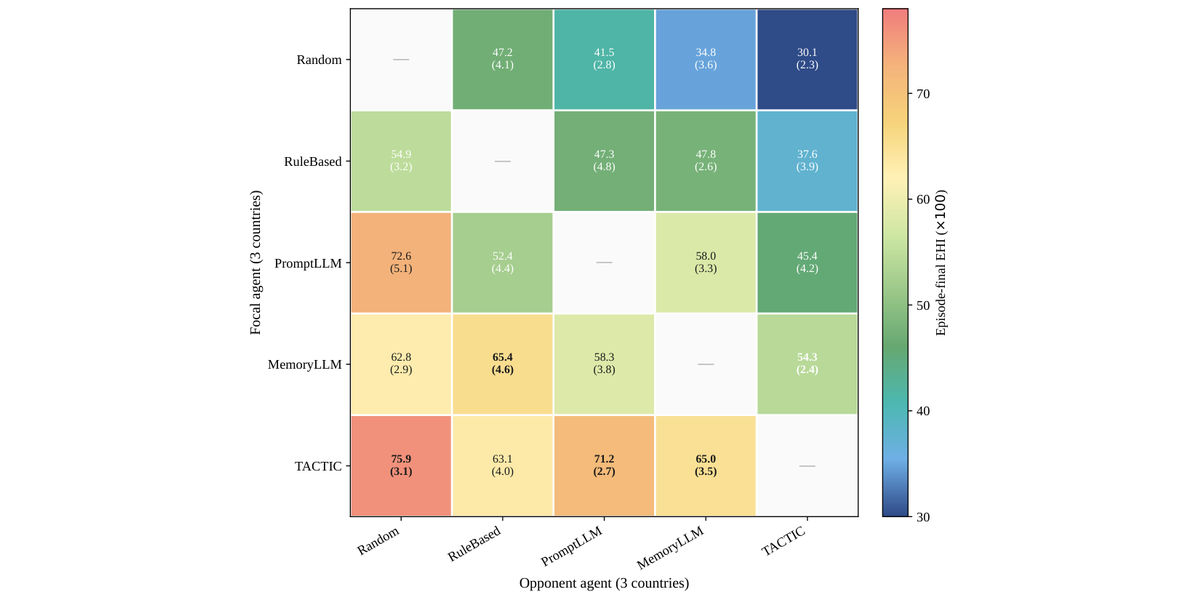
Kong, Yang and Hou report TradeWar, a six-country trade simulation in which dialogue is grounded into signed tariff and trade-share commitments, settled under capacity and network constraints, and scored with an Economic Health Index (EHI). The comparison includes Random and RuleBased policies plus three LLM agents, PromptLLM, MemoryLLM and TACTIC, which use GPT-4o-mini with the same chain-of-thought instruction. Across 100 baseline cross-play games, PromptLLM reaches 75% agreement and 57.1 mean final EHI (x100), versus 68.8 for TACTIC. TACTIC has the highest focal-agent EHI against three of four opponents, but MemoryLLM scores higher against RuleBased (65.4 versus 63.1). In a separate 20-episode adaptation experiment averaged over three seeds, TACTIC's final EHI rises from 58.2 to 73.2, versus 65.2 at the end for TACTIC-static, which resets persistent state between episodes.
Assessment
TradeWar makes post-settlement value an explicit evaluation target rather than equating agreement with success. Its contrast between agreement frequency and executed outcomes is useful for cooperation benchmarks, though the scale and meaning of value depend on this simulation's economic model.
Submitted October 30; first announced in the November 2 cs.AI listing.
Coordination research
- Authors’ claims
Parallel agents do better when they ask peers for help on demand
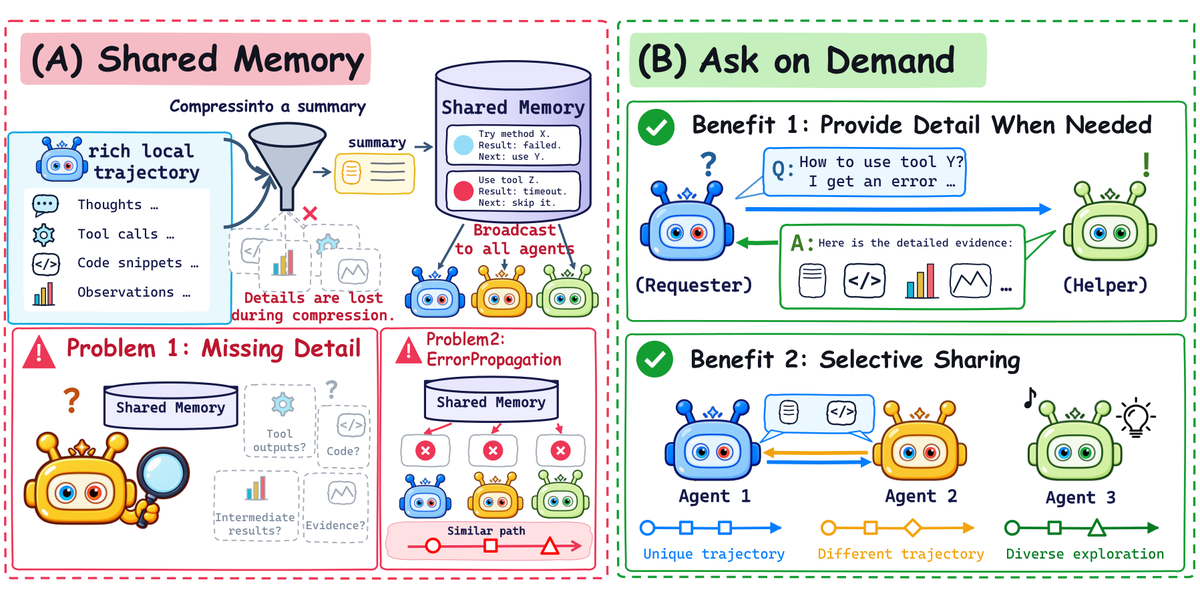
Yang, Yin, Bi and colleagues report Ask on Demand, where parallel LLM agents request targeted help when a specific information need arises. A trained Qwen3-0.6B gate approves requests, then a selected peer answers using evidence from its execution history. With three agents per task and frozen Qwen3.5-35B-A3B or Qwen3.5-4B task models on AppWorld and WebShop, AOD beats independent parallel execution on both selected performance metrics in all four model and benchmark settings. On 35B AppWorld, task goal completion rises from 53.89% to 62.78%, an 8.89 percentage-point gain. AOD leads the sharing baselines on selected performance in three of four settings; LTS (Adapted) leads on 4B AppWorld. AOD uses fewer tokens than PeriodicShare and LTS (Adapted) in all four settings, but Agentfugue (Adapted) uses fewer than AOD in three.
Assessment
The framework tests communication as a decision learned from team outcomes and token cost, rather than a fixed broadcast schedule. It addresses the risk that early summaries omit details needed later, while its remaining final-selection failures show why stronger candidate trajectories need not yield the best chosen answer.
Submitted October 30; first announced in the November 2 cs.AI listing.
Listen
Cognitive Revolution: agent-run companies and deal brokerage
Nathan Labenz and Prakash Narayanan discuss agent-run companies with Union's Samvit Ramadurgam, who describes agents brokering introductions and deals and an internal organization with an AI marketing lead and subordinate agents. The hosts probe what remains for human workers when execution shifts to agents. The same episode includes Arena's Anastasios Angelopoulos on evaluating behavior in production rather than relying solely on fixed tests.
Assessment
Useful practitioner commentary on delegation and agent-mediated markets, alongside an evaluation discussion. It offers questions for cooperation benchmarks, not measured evidence that the described organization or market works.
Published October 31; catch-up Listen coverage.
Also seen
- Authors’ claims
- Catch-up item
VerifyMAS: verify failure hypotheses against whole trajectories
Qiao, Tong, Lim and colleagues report VerifyMAS, an error-first approach to failure attribution in LLM multi-agent systems. It tests hypotheses drawn from a predefined error taxonomy against the full interaction trajectory, assigning entail, neutral or contradict, then identifies responsible agents only for supported hypotheses. The design targets failures that emerge across agents and steps rather than from a single local log.
Assessment
Failure attribution is the diagnostic half of cooperation evaluation; a hypothesis-verification approach over full trajectories is a plausible complement to outcome metrics when debugging multi-agent pipelines.
- VerifyMAS: Hypothesis Verification for Failure Attribution in LLM-based Multi-Agent Systems (arXiv) —
Originally submitted May 17; revised October 30 as v3 and covered here for the first time.
AG-UI adds structured recovery for A2UI sub-agent generation
The AG-UI maintainers report that ag-ui-a2ui-toolkit 0.0.6 adds A2UIGenerationError: adapters can return structured errors from a sub-agent call, and the recovery helper records the failed attempt and feeds those errors to the model on its next attempt within the existing limit. Transport failures and cancellation still propagate unchanged.
Assessment
A small but concrete reliability contract for delegated generation: failures become structured feedback instead of an undifferentiated retry. This is implementation news, not an evaluation of cooperation gains.
Released November 2 at 19:59 UTC.
Editorial synthesis
Both lead items distinguish intermediate behavior from final outcomes. TradeWar scores negotiated commitments after settlement, while Ask on Demand trains communication decisions on completed team continuations. For cooperation evaluation, this suggests measuring both the value realized by commitments and whether information exchange improves the answer actually selected, with model and opponent-specific exceptions kept visible.
Editorial interpretation of the cited sources.