
AI agent cooperation Instinct
Contract remedies fail on LLM agents, disclosure steers drivers
Frontier LLM agents play the hold-up game exactly as equilibrium predicts, so the contract remedy that rescues human investment gets zero adaptation. Disclosed rebalancing rules make self-interested LLM drivers accept most relocation offers. A listen asks why AI labs cannot slow down alone.
- hold-up
- contract-design
- algorithmic-management
- disclosure
- llm-agents
- coordination
Evaluation
- Authors’ claims
Renegotiable options fail to prevent hold-up between frontier LLM agents
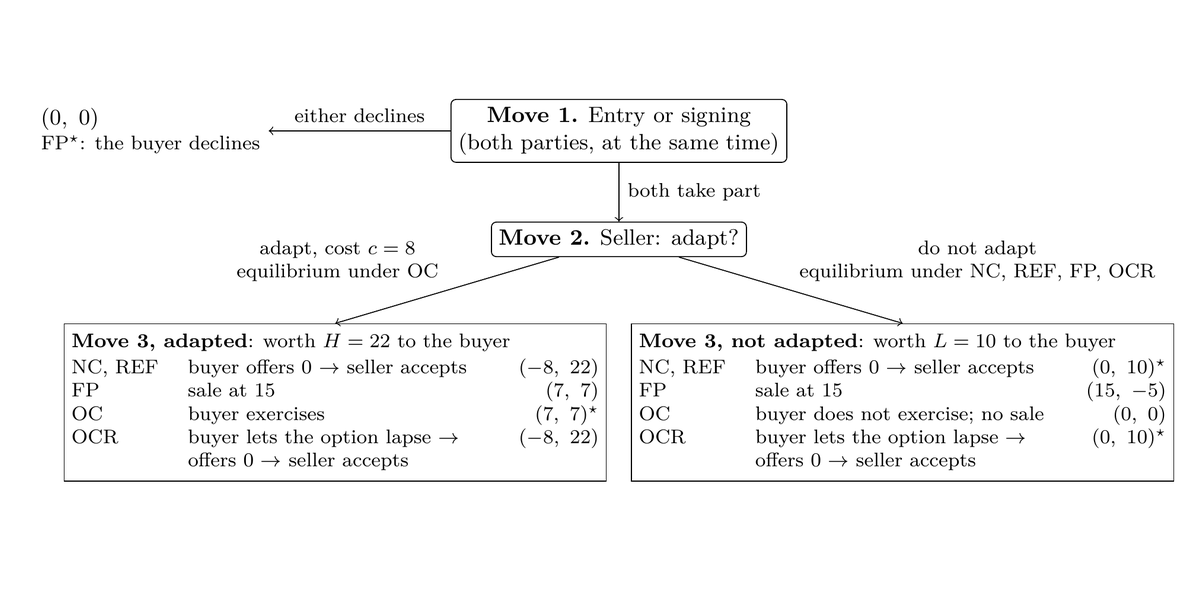
Yao, Yang, Zhou and colleagues report a hold-up experiment in which Claude Opus 5.5 and GPT-6.1 Sol, each instructed to maximize its own side's profit, play a one-shot game under five regimes across three seller and buyer pairings, 96 games per regime and pairing. The agents invest exactly where backward induction predicts: 0% adaptation under no contract, a non-binding reference price, a fixed price and a renegotiable option, and 100% under the option that rules out renegotiation, with identical rates in all three pairings. In Hoppe and Schmitz's human laboratory benchmark with the same strategic structure, the renegotiable option raised investment from 41.5% of pairs (22 of 53) without a contract to 67.2% (43 of 64), and the plain option to 90.9% (50 of 55). A remedy that works on people fails completely between profit-maximizing LLM agents, while the renegotiation-proof option works perfectly.
Assessment
For cooperation measurement this separates two failure modes: these agents do not underinvest through noise or misunderstanding but through exact equilibrium play, so institutions calibrated to human deviations cannot be assumed to transfer. Contract design for agent economies needs its own evidence base.
Submitted October 29; first announced in the November 2 arXiv listing.
Coordination research
- Authors’ claims
Compulsory disclosure steers self-interested LLM drivers toward platform policy
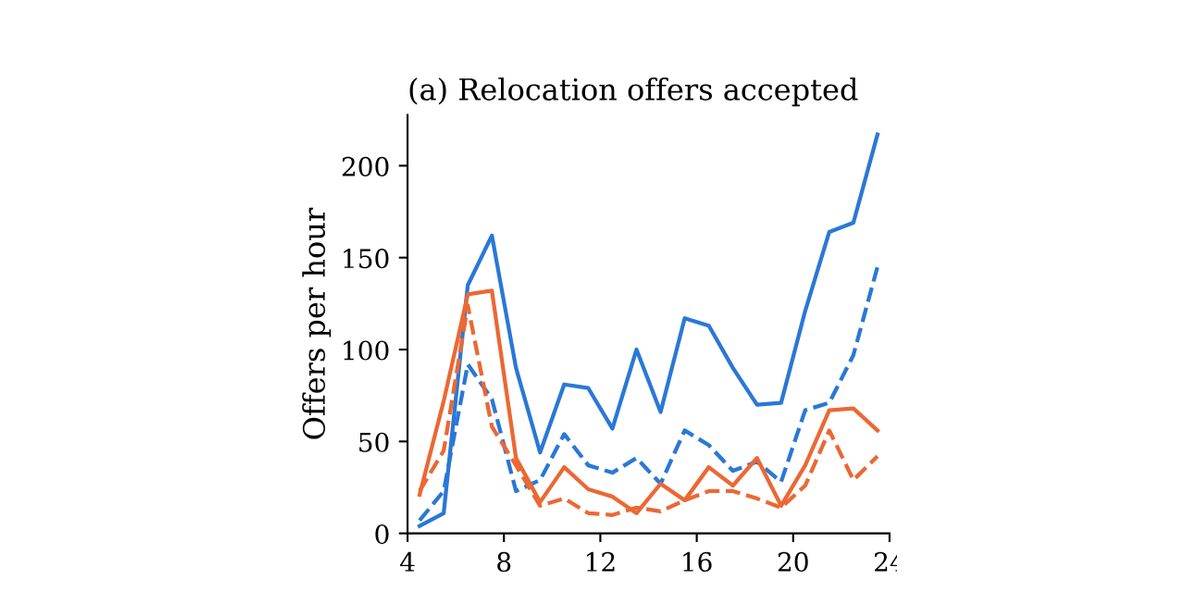
Wang and Fielbaum report a ride-hailing simulation in which every driver is an LLM agent maximizing its own net income and the platform's rebalancing rules are either withheld or disclosed at the level of detail the EU Platform Work Directive requires from December 2026. In a small three-zone model with ten drivers, both Claude Haiku 5.5 and Jev answered every comprehension question correctly and, once the rules were disclosed, moved less on their own and earned more. In a Manhattan network with 500 Jev agents, the share of relocation offers accepted rose from 22% without disclosure to 75% with it under both a reactive and an anticipatory rebalancing policy, and behavior under the two policies became almost identical.
Assessment
Transparency mandates written for human workers turn out to be readable coordination signals for machine drivers: disclosure aligned self-interested agents with the platform's plan without changing any incentive. That makes disclosure policy a live instrument for agent populations, with the caveat that LLM drivers are a modeling choice, not verified proxies for human drivers.
Submitted October 30; first announced in the November 2 arXiv listing.
Listen
80,000 Hours: why Silicon Valley cannot slow down AI on its own
Luisa Rodriguez examines why competitive pressure stops AI developers from slowing down unilaterally, then evaluates candidate mechanisms one by one: safety checkpoints, speed limits on development, limits on AI-assisted AI research and outright pauses, asking what each would actually buy and who could implement it. This is commentary on coordination among AI developers and the institutions around them, not evidence about agent-to-agent cooperation.
Assessment
A clear map of the human coordination problem that frames much of the multi-agent research this report tracks; useful context for judging proposals that rely on labs restraining themselves.
Episode of October 27, six days before this report; catch-up coverage carried from the November 1 coverage audit.
Also seen
- Authors’ claims
LLM bargaining over shared road space in mixed-autonomy traffic
Zhou, Chen and Li report a framework for population-level bargaining over shared road space between autonomous and human-driven vehicle agents, varying traffic density, agent objectives and traffic-domain knowledge. Agreement rates differ across conditions, and the paper proposes a behavioral taxonomy of how the bargaining process shapes outcomes.
Assessment
An applied take on LLM agents negotiating with each other at population scale; the taxonomy may be reusable outside traffic.
Submitted October 30; first announced in the November 2 arXiv listing.
- Authors’ claims
Silent teams can read a shared adversary's reaction as a signal
Falco argues that a team whose members cannot communicate can still learn what no member knows alone by reading how a shared adversary reacts to the group as a whole, treating that reaction as a tell. The paper claims a team committed in advance to its response never loses when the opponent cares more about its own goals.
Assessment
An unusual angle on implicit coordination: information about the group extracted from an adversary's behavior rather than from teammates.
Submitted October 29; first announced in the November 2 arXiv listing.
- Authors’ claims
Robust play when beliefs about other agents are wrong
Park, Shen, Milzman and colleagues report an ego-agent formulation for non-cooperative dynamic games that stays tractable without assuming agents share sensor measurements or maintain a common estimate of state uncertainty, assumptions they note quietly import cooperation into noncooperative settings.
Assessment
A useful reminder that standard multi-agent models smuggle in coordination structure; relevant when reading benchmarks that assume shared observations.
Submitted October 29; first announced in the November 2 arXiv listing.
Unverified leads
- Unverified lead
A2A v1.1.0-rc tag exists, contents unannounced
A v1.1.0-rc tag appeared on the A2A protocol repository on October 29. As of November 2 there are no release notes or announcement, so what the release candidate would change is not yet public.
Assessment
Worth watching because A2A version changes shape the agent interoperability surface; nothing to evaluate until notes or a release appear.
Tag created October 29; checked again November 2 with no notes published.
Editorial synthesis
Today's papers look at institutions rather than models. The hold-up result shows contract terms that rescue human investment failing exactly, not approximately, when both parties are profit-maximizing LLM agents, while the disclosure study shows a transparency rule written for gig workers doubling as a coordination signal for machine drivers. Together they argue that cooperation infrastructure for agent economies has to be re-evaluated on agents, not inherited from human evidence. The listen takes up the same question one level up, among the labs themselves.
Editorial interpretation of the cited sources.