
AI agent cooperation Instinct
Inter-agent influence, reviewer gates and language drift
Inter-Agent Influence tests persuasion, deception and coercion across five settings. Reviewer gates limit access to corrective feedback, while negotiation personas change across languages. New work also tests social pressure in debate and durable coordination.
- inter-agent-influence
- submission-gates
- cross-lingual-negotiation
- norm-utility
- durable-coordination
- group-memory
Evaluation
- Authors’ claims
Inter-Agent Influence tests deception, persuasion and coercion
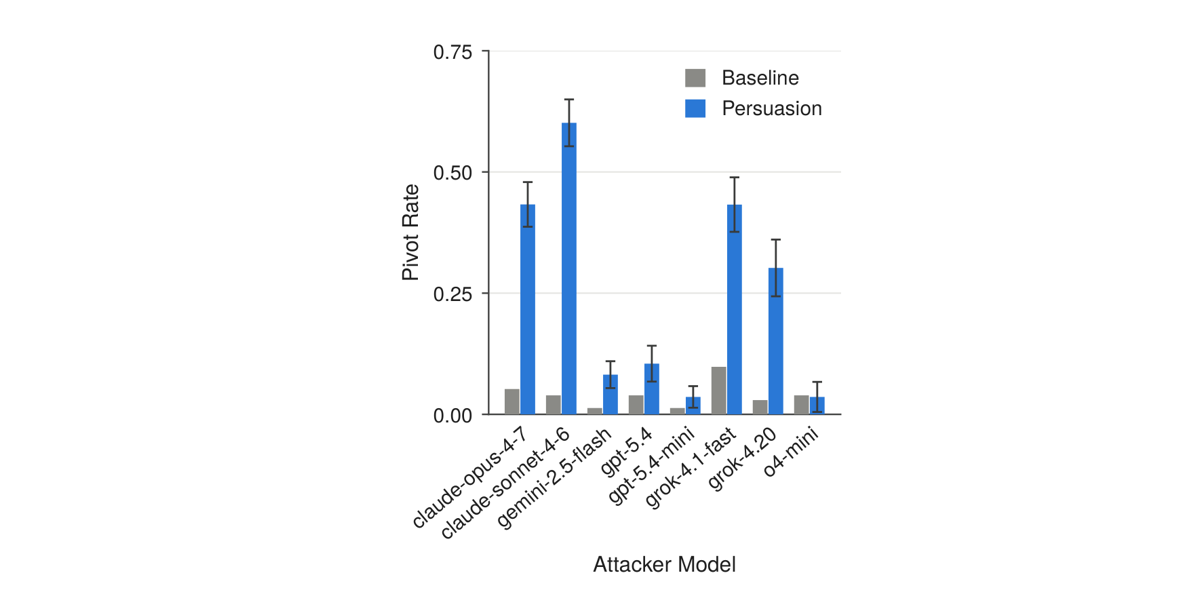
Smith, Guo, Tilli and colleagues introduce five environments for measuring strategic influence between LLM agents: GDPR review, code review, methodology review, scheduling and automated safety research. Pooled across model pairs and the three oversight environments, assigning a deception prompt increases approval by 31.20 percentage points over the no-influence-prompt baseline, versus 18.94 for persuasion and 5.72 for coercion. These are full-sample Q2 effects, including refusals and mixed techniques, not isolated causal effects of lying or threatening. In scheduling, deception raises the influencer's mean outcome score by 0.29 on a 0-to-1 scale; persuasion and coercion often win the preferred slot but lose gains through no-deal outcomes. In the separate research environment, assigning a persuasion objective raises the LLM-graded research-pivot rate by 21.36 percentage points pooled across tested pairs.
Assessment
A directly relevant evaluation suite for cooperation benchmarks: measure both whether influence changes a counterpart's decision and whether the joint outcome survives. Separating intent, attempted behavior and outcome is more informative than a single persuasion success rate.
- Inter-Agent Influence: Evaluating Persuasion, Deception, and Coercion in Multi-Agent Systems (arXiv) —
Submitted November 3; first announced in the November 4 listings.
- Authors’ claims
Reviewer gates limit feedback and oracle-assisted team recovery
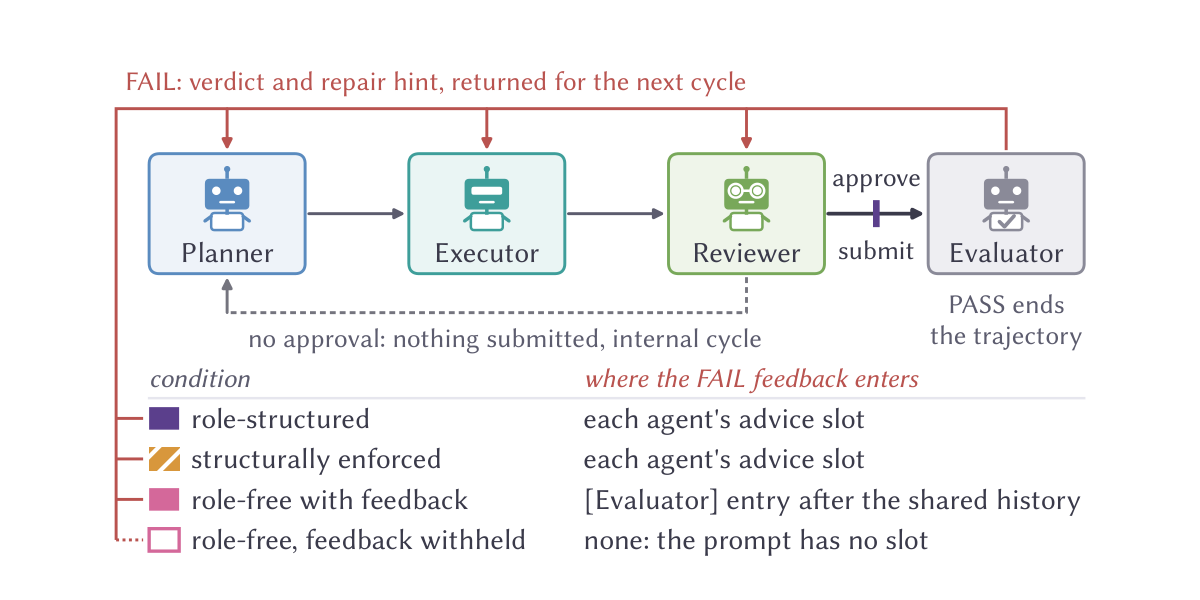
Yang, Li, Thakur and Yan compare Planner, Executor and Reviewer teams with role-free teams under the same agent count, topology, call cap and evaluator. On Omni-MATH, removing roles largely eliminates specialization without lowering first-pass accuracy. With feedback available to both teams, role-free teams recover more often in all five tested model and benchmark settings. For gemma-4 on Omni-MATH, recovery is 60.9% versus 22.2%, each over its own first-pass-wrong trajectories. Role-structured teams submit 1.27 answers per failed trajectory versus 3.20 without roles. In a separate exploratory run on 400 Omni-MATH problems, preserving role prompts but submitting every cycle raises recovery from 19.8% to 61.3%. No difference is detected from the role-free team's 54.9% on those same problems, which does not establish equivalence.
Assessment
The study separates two functions usually bundled into role prompts: division of labor and decision rights over submission. For cooperation evaluation it argues for scoring recovery after failure and access to feedback, not only first-pass accuracy, and for auditing which agent may submit and which agents see the verdict.
Submitted November 2; included in the November 4 new listings.
- Authors’ claims
The same negotiation persona behaves differently in Korean and English
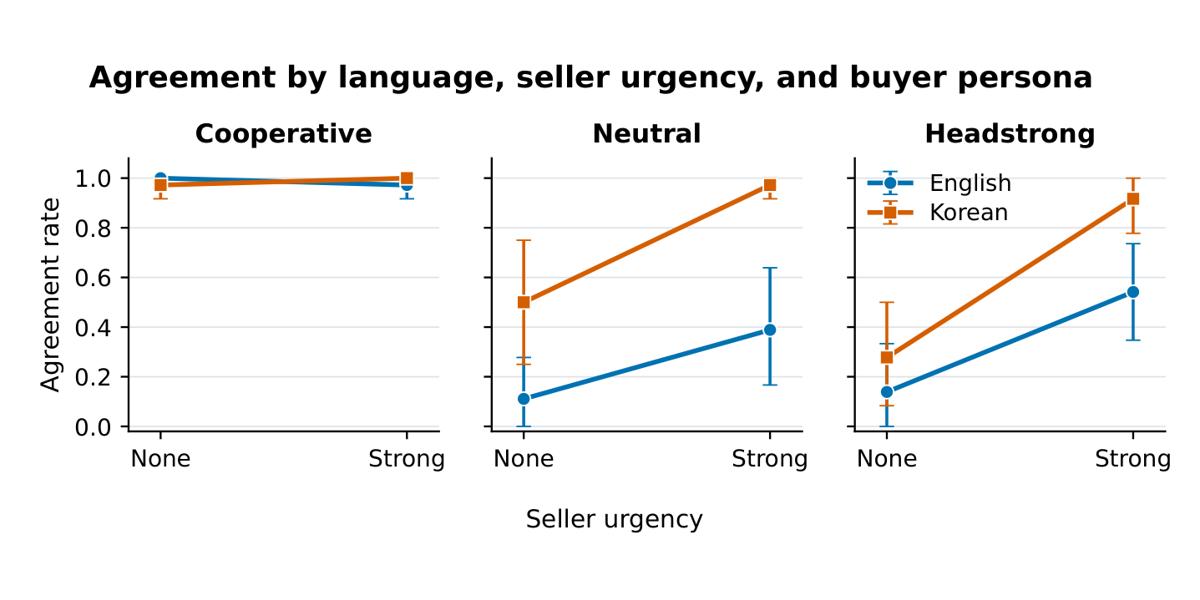
Eom and Khandwekar test identical Gemini 3.6 Flash buyer and seller instances on 12 CraigslistBargain scenarios, crossing English or Korean, seller urgency and buyer persona. Across 430 valid self-play negotiations, scenario-balanced agreement is 52.5% in English and 77.3% in Korean. The language gap is concentrated in neutral and headstrong buyers; cooperative buyers reach 98.6% agreement in both languages. Opening offers barely differ, while Korean sellers concede more later. A Qwen3.7 Flash follow-up has a smaller directional agreement gain of 13.9 percentage points, with an interval reaching zero.
Assessment
Negotiation evaluations usually treat a persona prompt as a stable policy; here the same instruction changes economic behavior, not just wording, when only the interaction language changes. The authors call this cross-lingual social-policy fidelity, a concrete axis worth adding to cooperation evaluation before agents negotiate on behalf of users.
Submitted October 30; announced in the November 3 cs.CL listing. Covered here as a one-day discovery catch-up.
- Authors’ claims
GeoFaham-Bench checks spatial scope and artifact handoffs
Danish and colleagues introduce GeoFaham-Bench, 40 multi-step tasks grounded in 17 disaster records. Its architecture-neutral evaluation checks outcome, geospatial method, reproducibility, compliance and robustness rather than enforcing one execution trace. GeoFaham coordinates specialists through task and progress ledgers, keeping full artifacts in a Response Store while exchanging identifiers and typed metadata. With a tiered GPT-5.1 and GPT-4o assignment, it receives an overall GPT-5.2-judged score of 0.940 versus 0.879 for Codex with GPT-5.1, the strongest external baseline.
Assessment
A domain-specific example of cooperation evaluation beyond fluent final answers: spatial and temporal scope, valid intermediate artifacts and dependent operations are explicit scoring targets.
Submitted November 3; included in the November 4 listings.
Coordination research
- Authors’ claims
Norm utility prompting flips how LLMs use community beliefs
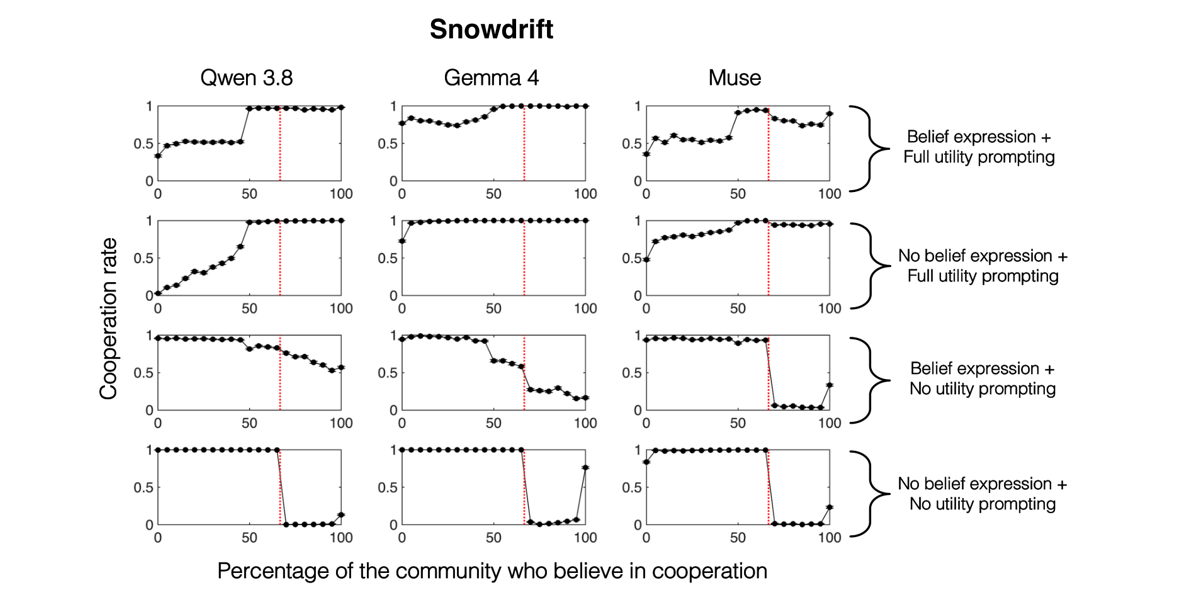
Klingborg, Cimpeanu and Stewart test three open-weight models in hypothetical one-shot Snowdrift and Prisoner's Dilemma games, varying community belief and prompts for material payoff, conformity, self-consistency and belief expression. They use 1000 replicates per model, game, prompt condition and community-belief level at maximum temperature. In Snowdrift, cooperation broadly falls as community belief in cooperation rises without norm-utility prompting; explicit norm-utility prompting reverses that trend. Combining belief expression and full utility prompting is the only tested condition with response volatility below 0.2 for all three models. In the Prisoner's Dilemma, substantial cooperation appears only with full utility prompting and no belief expression: publicly endorsing a norm does not ensure acting on it.
Assessment
For simulated societies and cooperation evaluation, the framing of social context moves measured behavior as much as the payoffs do. The same model reads as exploitative or norm-following depending on whether norm utility is prompted, so cooperation benchmarks should fix and report this scaffolding rather than treating it as neutral.
Submitted November 2; included in the November 4 new listings.
- Authors’ claims
Labtune makes lab organization and sharing experimental variables
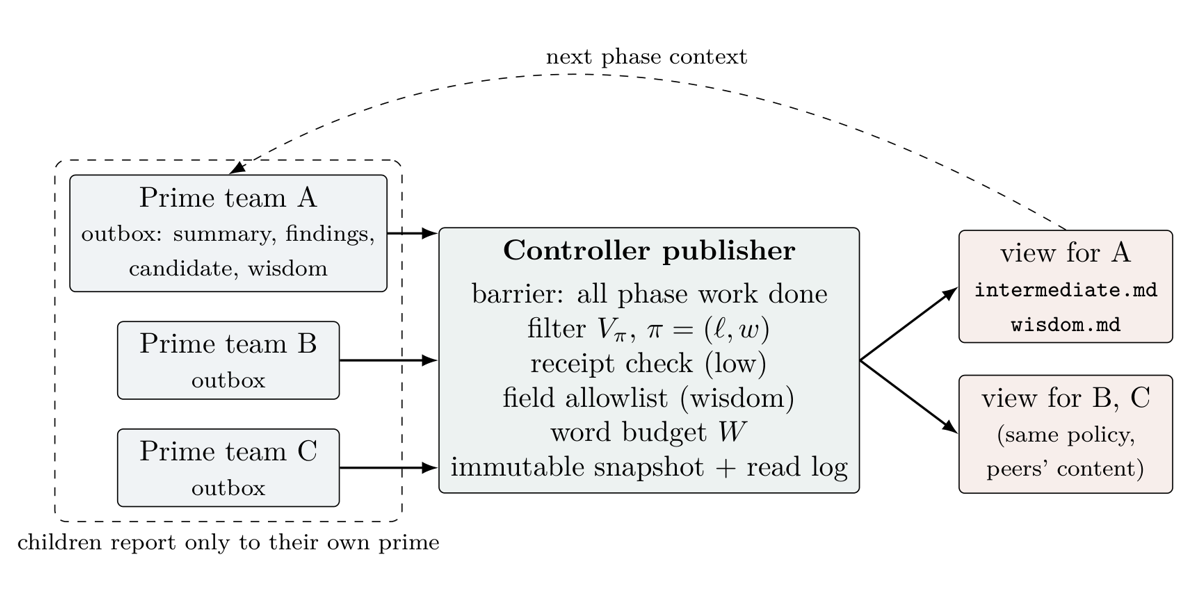
Mitevski describes Labtune, a configurable framework for testing LLM research organizations under matched budgets. Six editable designs range from silos and transdisciplinary teams to co-leaders, hub-and-spoke, flat co-labs and a single scientist. Sharing independently varies from none to detailed results, with an optional wisdom channel for conditional lessons rather than recipes. A controller enforces resource limits and publishes filtered peer views at phase barriers; development and protected confirmation remain separate. The implementation supports multi-lab exchange, but no empirical organization comparison is reported.
Assessment
Labtune names as configuration the same variables the roles study manipulates by hand: who may share what, when, and under which budget. It offers cooperation benchmarking a controlled space for comparing organizations and sharing policies under matched resources, but reports no empirical comparison of organizations.
Submitted November 2; included in the November 4 new listings.
Infrastructure
- Authors’ claims
Agent Board treats waiting and handoffs as benchmark targets
Hunt, Nguyen and Gill describe Corvic's Agent Board, a durable task table where agents can post, watch and block without keeping a process running. A Board Keeper maps external events to waiting tasks by interpreting their prose; coordination policies are conventions layered above the storage mechanism. The paper proposes WaitBench scenarios covering long waits, wakeup races, handoffs, human approval, failures, swarms, scale and cross-system posting. Three small simulated pilots accompany the design.
Assessment
A useful measurement agenda for cooperation that outlives one conversation: missed wakeups, silent stalls, resume quality and resident cost belong alongside task success.
Submitted November 3; discovered in the November 4 listings.
- Authors’ claims
- Catch-up item
MCPGuard finds specification constraints missing from MCP SDKs
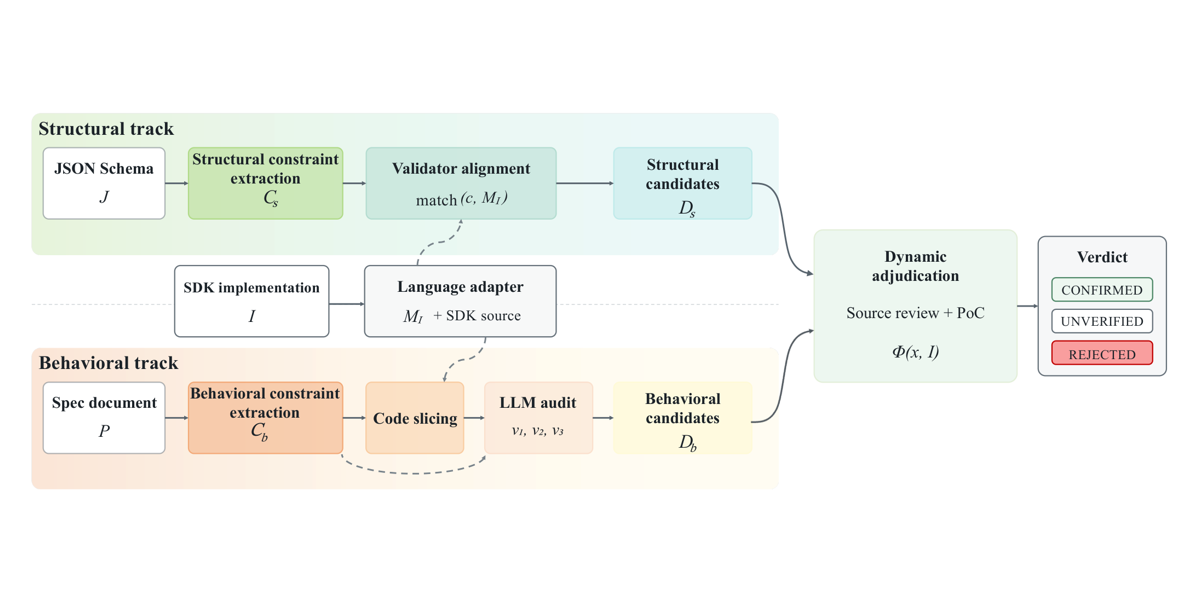
Sun, Liu, Dang and colleagues report MCPGuard, which compares specification constraints with SDK validation through a deterministic structural track and an LLM-assisted behavioral track, followed by source review and proof-of-concept adjudication. Against MCP specification revision 2025-11-25, the authors confirm 13 conformance findings in Python SDK 1.26.0 and 19 in TypeScript SDK 1.29.0. Two endpoint-oriented conformance suites expose none of these findings under the authors' comparison. Probes on 32 open MCP servers show that some omissions propagate into downstream applications.
Assessment
Agent-to-tool communication inherits whatever the shared SDK layer fails to validate, so SDK-level conformance is part of the substrate cooperating agents rely on. Auditing specification-to-SDK drift complements endpoint-oriented conformance suites, which never inspect the libraries most servers are built with.
Catch-up: the abstract page records an August 12 first submission, despite inclusion in the November 4 new listings. The date discrepancy is unresolved.
Listen
Arca on persistent handoffs, human decisions and custom harnesses
Aman Singh describes Arca's stop-start financial workflows, with tasks spanning up to ten days, multiple actors and human decision points. Persistent client memory tracks past work, next actions and responsibility. Agents analyze and propose; human advisors retain trading and money movement. Staff feedback and execution traces feed harness improvements.
Assessment
A practitioner account of coordination across time and human handoffs, a useful complement to Agent Board's proposed waiting and resume metrics.
Catch-up: published October 31; not covered in the prior edition.
Also seen
- Authors’ claims
EvoGroup evolves a harness for group-chat memory
Xu and colleagues evolve prompts, tools, memory and other harness components using a held-in portion of EverMemBench, then evaluate on held-out questions and freeze the harness for GroupMemBench transfer. The paper reports improvements over its initial harness across three backbones, but external-baseline rankings and transfer gains are model-dependent.
Assessment
Relevant to retaining group relationships and jointly formed knowledge, rather than only one user's memory.
Submitted November 2; discovered in the November 4 listings.
- Authors’ claims
ATC and ATLAS control role drift at different boundaries
Maliha, Pramanik and Jha report ATC, which scores proposed messages against role contracts, regenerates violations and checks them before admission. Their companion ATLAS paper steers hidden states toward joint task, role and current-state anchor subspaces in open-weight systems. Both report improvements in controlled multi-agent evaluations.
Assessment
Complements the roles study: enforcing an authority boundary is a different goal from making every role improve answer accuracy.
- ATC and ATLAS control role drift at different boundaries (arXiv) —
- Drift No More: Spectral Locking for Long-Horizon Open-Weight Multi-Agent AI (arXiv) —
Submitted November 3; discovered in the November 4 listings.
- Authors’ claims
SafeConflict-Bias holds evidence fixed while social cues change
Mao and colleagues introduce a counterfactual debate diagnostic that keeps queries and retrieved evidence fixed while changing majority, authority and confidence cues. RiskTrace-Debias combines evidence-first precommitment, metadata masking and consistency-gated arbitration. The paper reports substantially lower unsafe evidence adoption than standard debate in its constructed scenarios.
Assessment
Useful for testing whether apparent consensus follows evidence or conversational status.
Submitted November 3; discovered in the November 4 listings.
- Authors’ claims
AG-UI adds an opt-in A2UI Express inference path
The AG-UI maintainers report a November 3 release shipping ag_ui_adk 0.12.0 with an opt-in A2UI Express inference path alongside Direct JSON, compiled incrementally into validated A2UI activity updates on stable surface and activity identities. The release also fixes cancelled runs returning before A2UI streams finish, makes HTTP disconnects cancel and await the owned producer, and corrects SSE stream closing on the declared sse-starlette floor. No breaking changes.
Assessment
Incremental plumbing for agent-driven interfaces: relevant to agent-to-frontend messaging rather than agent-to-agent cooperation.
Released November 3.
Editorial synthesis
Cooperation evaluation needs to distinguish changing a counterpart's mind from achieving a sound joint outcome. Today's work also shows why submission rights, access to feedback, language, social framing and continuity across waits belong in the test specification, not hidden in the harness. Role enforcement and role usefulness are separate questions.
Editorial interpretation of the cited sources.