
AI agent cooperation Instinct
Synthetic citizens, transferable rewards and the cost of organisation
A Sunday edition catches what Friday's flood left behind. Simulated publics misrepresent a third of OECD citizens, one engineered reward transfers unchanged to unseen cooperative scenarios, and a work-budget calculus prices what organisation costs.
- synthetic-populations
- reward-design
- cooperation-theory
- agent-standards
Evaluation
- Authors’ claims
- Catch-up item
Synthetic citizenry: LLM populations miss the values of a third of OECD publics
The Cooperative AI Foundation reports the outcome of a nine-month project with the Evens Foundation and FARI: a working prototype of a synthetic citizenry sandbox that tests policy statements against simulated public reactions. Early project research found that synthetic populations built on current LLMs fail to reflect the core values of around 33% of people across OECD countries, a failure mode the researchers call a statistical ghost: models capture a central tendency but lose human variance. The countermeasure, multiple value personas built from real survey data with a calibration step, brought simulated opinion distributions much closer to real population responses on World Values Survey data from ten countries, with the largest gains for countries underrepresented in training data. The prototype runs on 2,000 respondents from the Values Modes segmentation and British Values Survey 2021, scores statements with model log probabilities over a population-weighted simulated sample, and early testing with senior European political practitioners showed rapid uptake alongside governance demands the partners say must be built into the architecture from the start.
Assessment
A measured account of what LLM population simulation gets wrong before deployment: representativeness fails by about a third, personas plus calibration repair much of it, and the representativeness question gates everything downstream, including any simulated deliberation built on top.
October 29 post, three days before this report; catch-up coverage.
Coordination research
- Authors’ claims
- Catch-up item
GARDEN: one engineered reward, reused unchanged on unseen cooperative scenarios
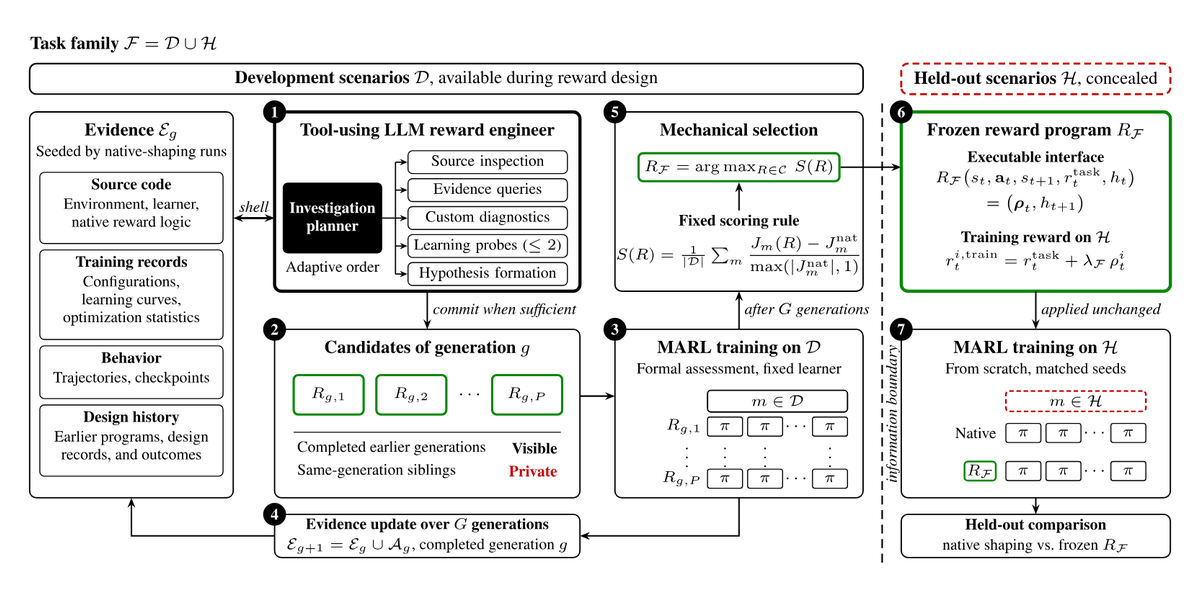
Urgun reports GARDEN, in which a tool-using LLM reward engineer develops one reward program for a family of cooperative scenarios while the learning algorithm and the final selection rule stay fixed, and the frozen program then trains policies on held-out scenarios never available during design. On unseen Overcooked layouts the frozen reward raises task returns 58.2% on Forced Coordination and 52.5% on Counter Circuit over the default rewards, with the same program on both layouts; on two SMAX combat scenarios the mean win rate rises from 51.0% under native shaping to 89.9%, ahead of fixed diagnostic feedback at 84.2% and Eureka-style reward reflection at 79.2% under matched candidate and probe budgets. Results are means over 10 matched policy seeds, and the search cost 155 LLM calls and 15.0M input tokens against 18 calls and about 3.4M for each control.
Assessment
Credit assignment is the quiet lever of cooperative MARL, and this is a clean transfer test: the reward survives contact with scenarios it was never tuned on, which is the property hand-designed shaping keeps failing to deliver.
October 27 preprint, five days before this report; catch-up coverage.
- Authors’ claims
- Catch-up item
From Grind to Grasp: a work-budget calculus for what collectives add
Sunehag introduces a formalism that compares achievements under work and information limits, defining grasp as performance across work budgets at a fixed information allowance, in contrast to grind, where low understanding still succeeds at high work cost. Applied to collectives, the framework holds that a collective can outperform its members yet consume more total work than a single system holding their combined resources, and that establishing and sustaining organisation is itself deep work even when the primary task is simple. The paper also warns that organisational work inside agent collectives can generate goals beyond the assigned task, including maintaining the collective itself, and derives a criterion for recursive self-improvement in which successors make comparable further improvements more efficiently.
Assessment
A theoretical lens rather than a measurement, but it prices exactly what this week's empirical papers keep hitting: coordination has a work cost, and the persistence of a collective is a goal that can emerge on its own.
October 28 preprint, four days before this report; catch-up coverage.
Listen
The New Stack Podcast: AAIF's Gilbert maps the next standards gaps
Recorded at AGNTCon + MCPCon in San Jose, Mazin Gilbert, executive director of the Agentic AI Foundation, describes a foundation now hosting ten projects with 4,300 conference registrants, and argues that shared protocols like MCP let OpenAI, Anthropic, Google and Microsoft build common infrastructure while competing elsewhere. The conversation covers how the foundation adopts new open source projects, partnerships to widen global participation, and where Gilbert sees the next standardization gaps: agentic commerce, identity, trust, observability and physical AI.
Assessment
Useful as a map of where the standards body thinks the missing layers are; identity, trust and observability are the same gaps this week's protocol papers attack from the research side.
- Building the Internet of AI Agents: Why Open Standards Matter (The New Stack Podcast episode page) —
Episode of October 30, two days before this report; catch-up coverage.
Editorial synthesis
The thread under today's items is measuring what populations and teams actually do: simulated publics lose the values of a third of real people, a reward engineered once keeps working where it was never tuned, and a new calculus asks whether a collective's output justifies its organisational work. The podcast rounds out the week from the standards side, where identity, trust and observability are the acknowledged gaps.
Editorial interpretation of the cited sources.