
AI agent cooperation From the report of
Grading under attack, harnesses that cannot recover, seniors that bend
- Authors’ claims
Claims drift at every handoff; provenance records hold the line
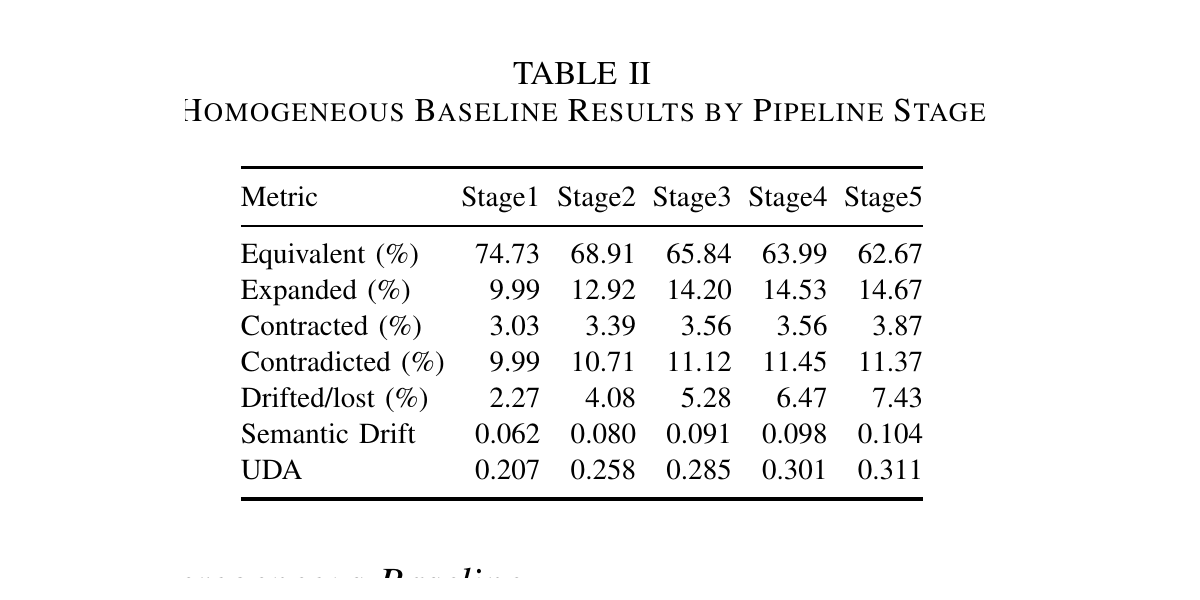
Cao and Dou report what happens to a claim as it passes through five-agent pipelines built from homogeneous or heterogeneous model chains, using FEVER claims whose correct verdict is not enough information. In the homogeneous baseline, outputs judged equivalent to the original claim fall from 74.73% at stage one to 62.67% at stage five, while expanded claims rise from 9.99% to 14.67%, drifted or lost content from 2.27% to 7.43%, a semantic drift index from 0.062 to 0.104 and unsupported detail addition from 0.207 to 0.311. Their provenance-aware framework, which attaches a structured record of status, source, evidence and transmission history to each claim, keeps equivalent outputs at 98.07% to 96.95% across the five stages in the homogeneous setting, holds unsupported detail addition at 0.014 to 0.021, and reports provenance preserved rates of 84.32% to 93.57% per stage.
Assessment
The baseline table alone is worth the read: even when every agent runs the same model, meaning erodes measurably at each handoff, so chaining agents is not neutral plumbing. The framework's near-flat equivalence across stages suggests cheap structured records can carry most of the weight that heavier verification layers are asked to carry.
Submitted November 20; appeared in the November 23 listing.