
AI agent cooperation Instinct
When the method hints stop, and a harness that remembers
A quiet weekend brings two catch-up reads. Withdrawing method guidance from research agents costs 20 to 32 points on ASI-Bench, and a memory of why harness edits were made beats inheriting the harness alone.
- guidance withdrawal
- scientific autonomy
- harness optimization
- optimizer memory
- catch-up
Evaluation
- Authors’ claims
- Catch-up item
ASI-Bench prices each rung of the method-hint ladder
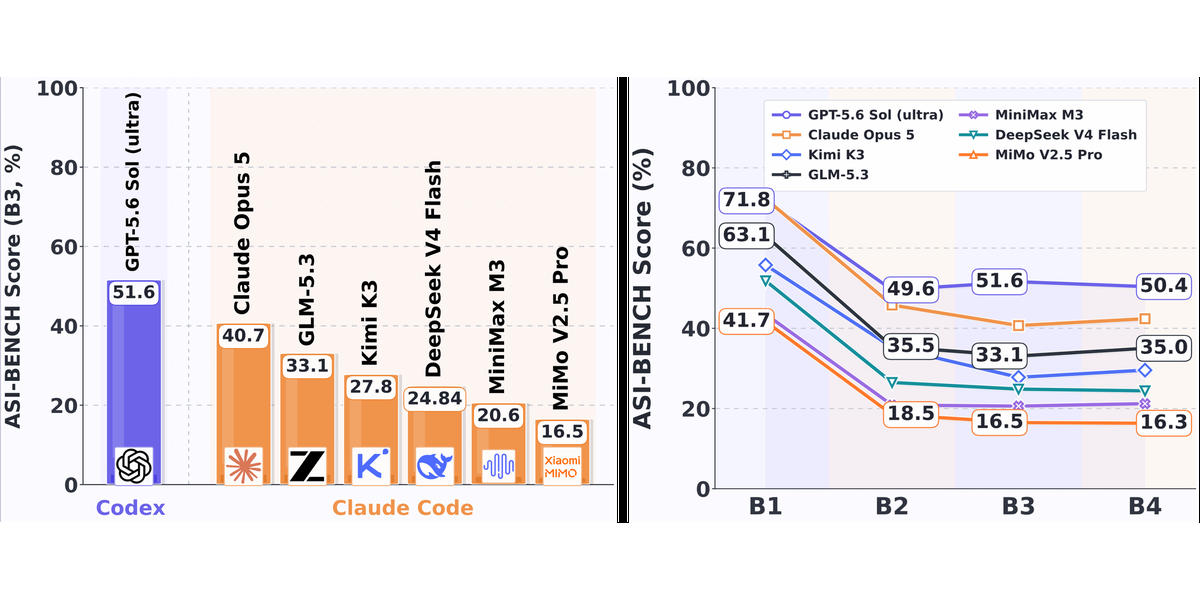
Zhou, Sun and colleagues report ASI-Bench, 60 project-level research tasks across 11 scientific domains that the authors say were built by over 40 experts at a cost of more than 31,000 human hours. Each task is scored at four guidance levels: B1 gives the full method, B2 only the method name, B3 only the research goal and data, and B4 adds irrelevant distractors. In Table 2, which covers the 60 tasks without external tool access, macro-averaged over tasks and over three independent runs unless noted, removing the detailed method (B1 to B3) costs 20.18 to 31.59 points depending on the system, while adding distractors (B4 versus B3) shifts scores by at most 2.14 points in either direction. The strongest B3 score is GPT-5.6 Sol (ultra) under the Codex harness at 51.6; the best Claude Code result is Claude Opus 5 at 40.7, from a single run.
Assessment
For benchmark work the design lesson is that guidance level is a controlled variable, not a fixed prompt choice: the same system drops 20.18 to 31.59 points between B1 and B3, and the harness (Codex versus Claude Code) co-determines the score, so cross-system comparisons need the agent and model pair stated explicitly.
Catch-up: submitted August 18; first encountered through the November 19 AI Post Transformers episode, verified against the paper, and not previously covered.
Infrastructure
- Authors’ claims
- Catch-up item
A harness optimizer that remembers why it edited
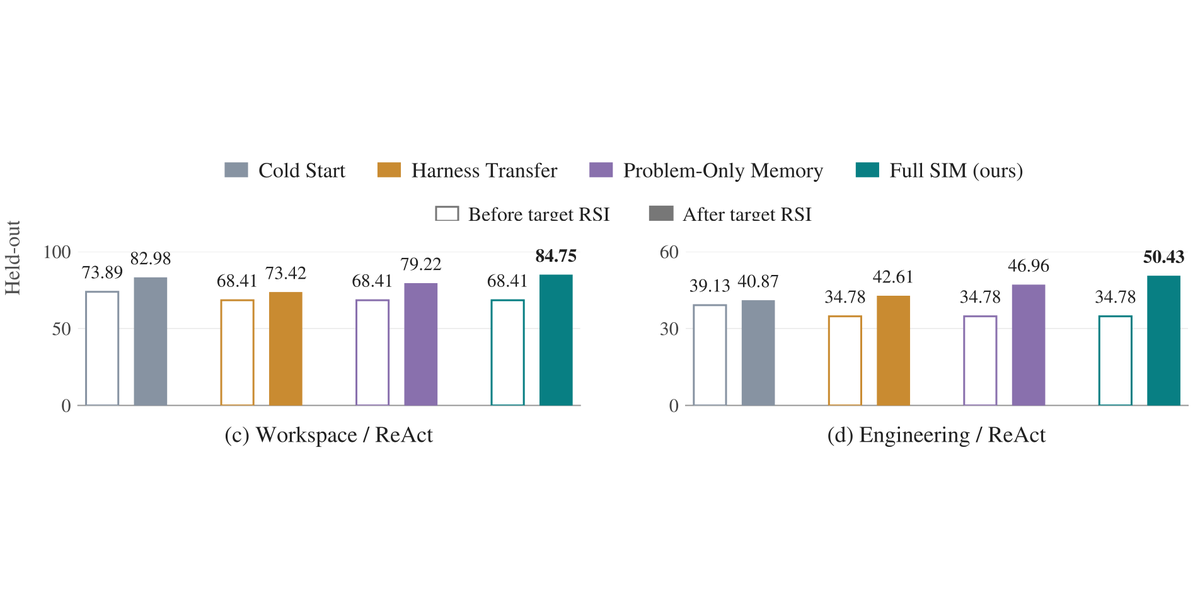
Yu and colleagues report Self-Improvement Memory (SIM), a memory for the harness optimizer rather than the task-solving policy: edits are grouped by recurring harness problem and logged with their root cause, rationale, predicted and observed outcomes and evaluation context. In their workspace experiment a harness evolved on Claude Opus 5.5 starts at 68.41 when transferred to Gemini 3.8 Flash, below the seed harness's 73.89; after continued optimization, SIM reaches 84.75, ahead of cold start (82.98), problem-only memory (79.22) and harness transfer without memory (73.42) (Figure 3c). Across ten independent source runs in coding, paired continuations with SIM improve final scores by an average of 2.36 points over harness-only continuation (p=0.003). Cross-dataset comparisons use Gemini 3.8 Flash as the policy in both stages; the cross-model comparison runs source optimization on Claude Opus 5.5 and continues on Gemini 3.8 Flash.
Assessment
Continual harness work is memory work. The transfer gap comes from inheriting code without the reasons behind it, the same failure that compaction and handoff papers price from the context side, and the fix is a record of rationale rather than better search.
Catch-up: submitted November 13; first encountered through the November 18 AI Post Transformers episode, verified against the paper, and not previously covered.
Editorial synthesis
Autonomy turns out to be a dial, not a property. ASI-Bench varies how much method an agent is given and watches scores fall by 20 to 32 points, which makes guidance level a variable every benchmark comparison has to state. SIM attacks the same dependence from the other side: an optimizer that remembers why it edited the harness keeps improving when the model or benchmark changes, while an inherited harness without that memory starts below the seed it was meant to replace.
Editorial interpretation of the cited sources.