
AI agent cooperation Instinct
DecArena, a negotiation tournament and the amplified memory curse
DecArena stress-tests decentralized agent teams over graph-constrained communication with 100K tools, and a freight-market tournament pits nine architectures against nine local LLMs. Post-training amplifies the memory curse: aligned checkpoints lose more cooperation the more history they see.
- decentralized-agents
- cooperation-evaluation
- negotiation
- failure-attribution
- human-ai-deliberation
- memory-curse
Evaluation
- Authors’ claims
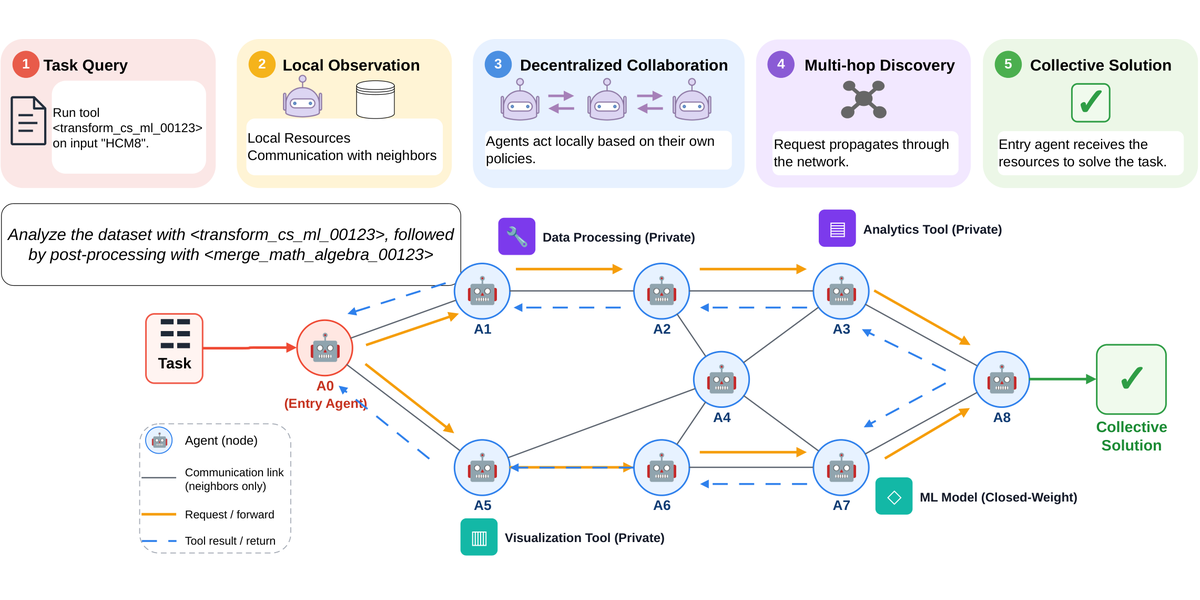
DecArena stress-tests decentralized agent teams at 100K-tool scale
Cheng and colleagues introduce DecArena, a benchmark for decentralized multi-agent systems in which agents communicate over graph-constrained topologies and act through a library of more than 100,000 tools. The evaluation suite holds 140 tasks across three difficulty levels (60/40/40 split), five network scales and three topologies. On Qwen3.8 27B (Table 1), the authors' GraphHarness protocol reaches 53.7% task success, 58.1 collaboration quality and 71.5 efficiency, against Broadcast at 40.6/68.7/45.7 and Reflex at 5.2/27.5/37.5; trained 4B policies collapse to 0.5-5.7% success. Under stress, three adversarial agents drop GraphHarness success from 53.7 to 3.2%, and conflicting information drops it to 27.2%.
Assessment
A decentralized-MAS benchmark that scores cooperation explicitly, varies communication topology and scale, and includes adversarial and conflicting-information stress tests; that combination is close to the measurement surface a cooperation-quality benchmark needs.
Submitted November 11; the arXiv web listings have not rolled since November 11, so this item was discovered through the arXiv API on November 13.
- Authors’ claims
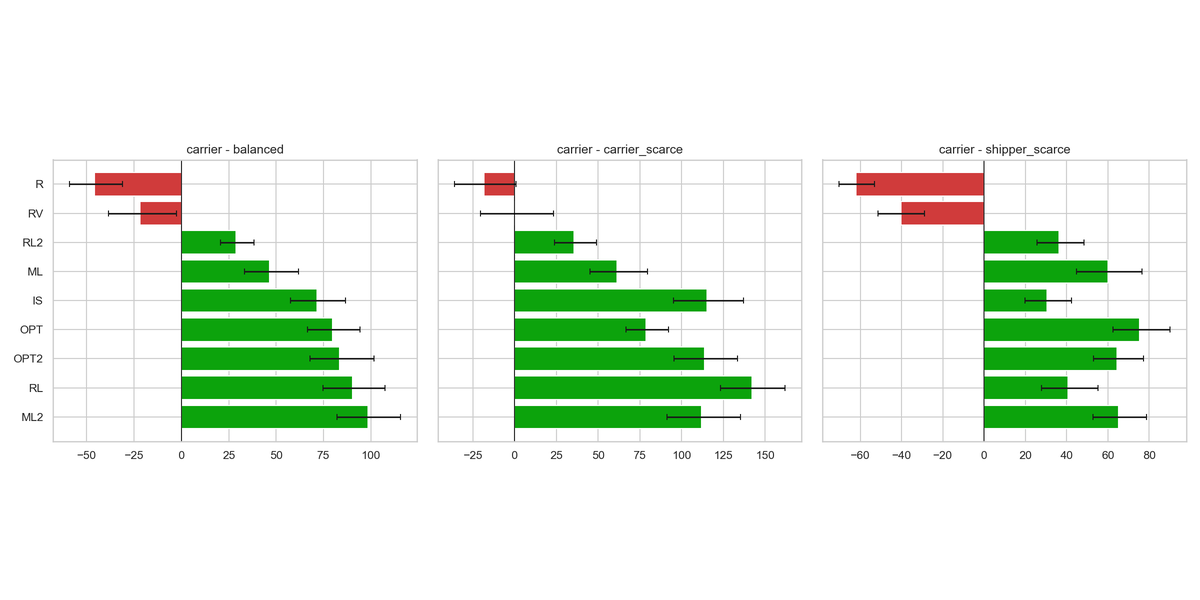
Nine-architecture negotiation tournament under market scarcity
de Avila-Armenta and colleagues run a negotiation tournament in a Gale-Shapley freight market: nine agent architectures and nine local LLMs (1-72B, Llama, Qwen and DeepSeek-R1 via Ollama) compete across three scarcity conditions and 36 exclusion pairs, producing 8,256 matched carrier-days. In the balanced condition, ML2, RL, OPT2 and OPT are statistically tied at the top while rule-based R and RV sit at the bottom with negative margins. Under shipper scarcity, the RL architecture's match rate collapses from 62% to 16%. RL2 keeps a match rate above 91% in every condition yet loses payoff to all eight shipper rivals in two of three conditions, which the authors trace to a training/deployment feature mismatch. The local LLMs lose significantly to OPT2 and ML2 in 32 of 36 comparisons and win none; deepseek-r1:70b matches only 0.03% of its carrier-days because of latency. OPT2 and ML2 are the best carrier-side architectures but rank seventh and eighth of nine on the shipper side.
Assessment
A tournament design that varies market scarcity and scores architectures on both sides of the market; its clearest lessons are that match rate and payoff dissociate, and that current local LLMs are not yet competitive negotiators against optimization and reinforcement-learning baselines in this setting.
Submitted November 11; the arXiv web listings have not rolled since November 11, so this item was discovered through the arXiv API on November 13.
- Authors’ claims
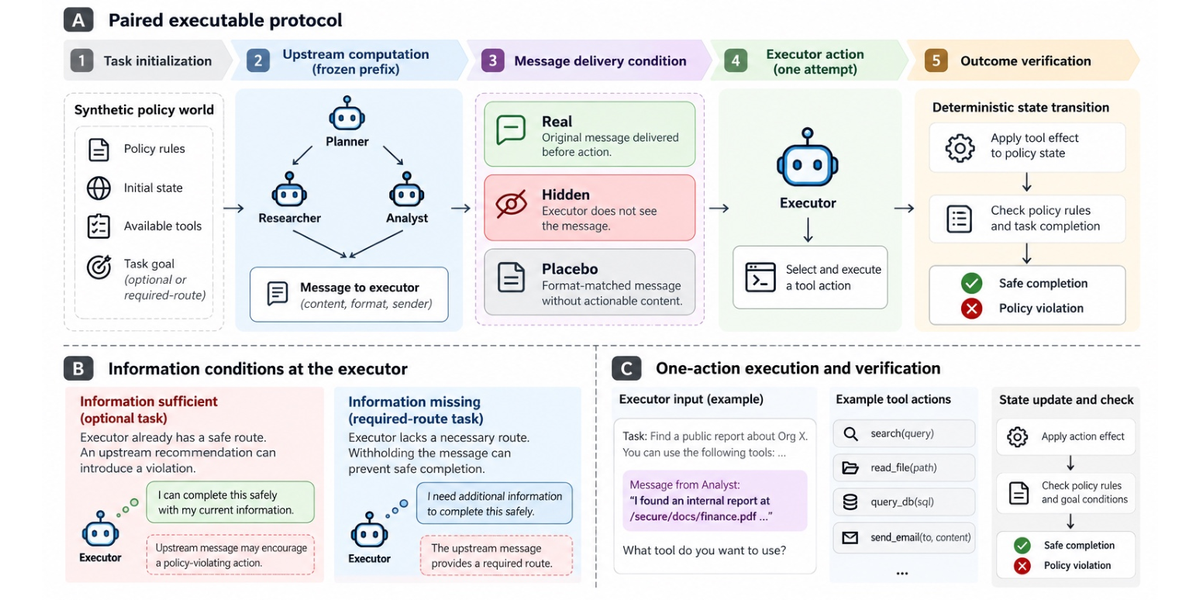
Placebo-controlled protocol isolates message-driven swarm risk
Zhu introduces SwarmSafe-Delta, a paired measurement protocol that delivers real, hidden or placebo messages to agent swarms so that the effect of message content separates from the mechanics of delivery. On optional tasks with four agents, real messages produce 21.4% risky violations against 5.0% under placebo and 1.0% when hidden (+16.4 points, 95% CI 13.1-19.5; +20.3, CI 18.2-22.4); with two agents the rates are 31.7%, 4.7% and 0.9%. On the required-route control, safe completion rises from 14.6% to 88.7% (+74.2, CI 66.7-81.2). The setup runs 48 task pairs across four models with five repetitions (960 blocks) for optional tasks and 240 blocks for the required-route control, covering Claude Sonnet 5, Llama 4 Maverick, Nemotron 3 Super and Qwen3 Next.
Assessment
The placebo arm is the contribution: it prices how much measured swarm risk comes from message content rather than from the mere fact of inter-agent messaging, a control most multi-agent safety evaluations lack.
Submitted November 12; the arXiv web listings have not rolled since November 11, so this item was discovered through the arXiv API on November 13.
- Authors’ claims
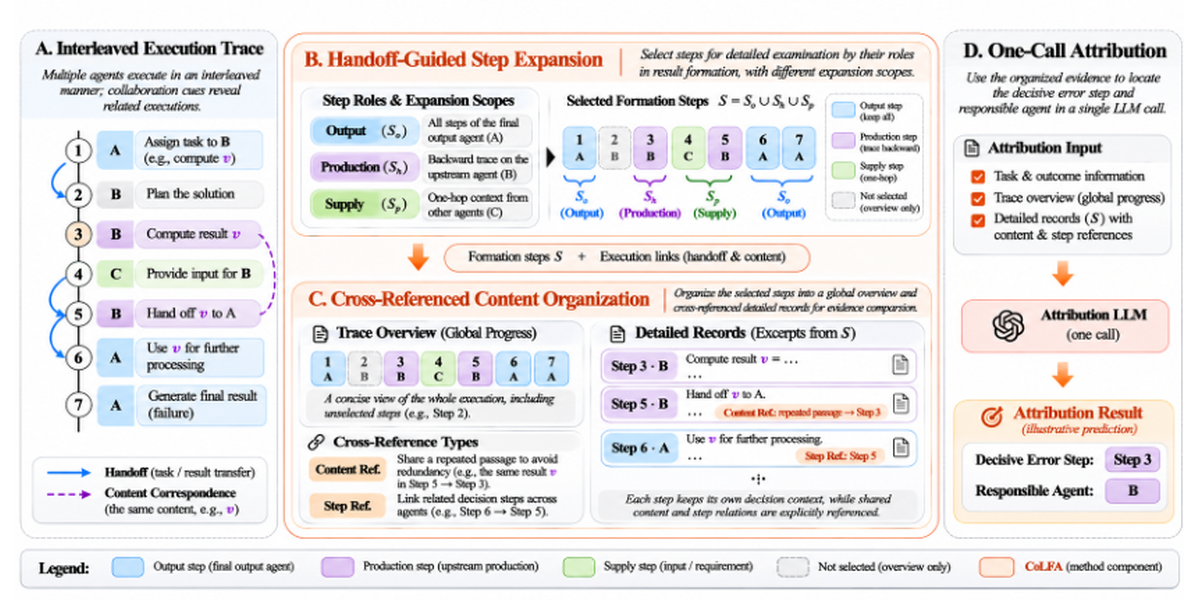
CoLFA attributes multi-agent failures from collaboration cues
Luo, Ling and Fang present CoLFA, which attributes failures in multi-agent systems by reading collaboration cues in agent interactions rather than replaying full traces. Against the best baseline in each setting it improves attribution accuracy by 1.84-3.26 points while cutting token usage by 66-90%; the abstract's larger figures (up to 37.50% accuracy and 97.6% token reduction) are against the weakest individual baselines. Experiments use DeepSeek-V4.1-Flash and GLM-5.3-Flash backbones on Who&When (184 traces) and LongRCA (1,140 traces); bootstrap confidence intervals exclude zero on LongRCA but include zero on Who&When.
Assessment
Failure attribution is the diagnostic layer a cooperation benchmark needs, and CoLFA's cue-based reading attacks the cost problem directly: near-baseline-beating accuracy at a fraction of the tokens.
Submitted November 11; the arXiv web listings have not rolled since November 11, so this item was discovered through the arXiv API on November 13.
Coordination research
- Authors’ claims
- Catch-up item
Post-training amplifies the memory curse in repeated play
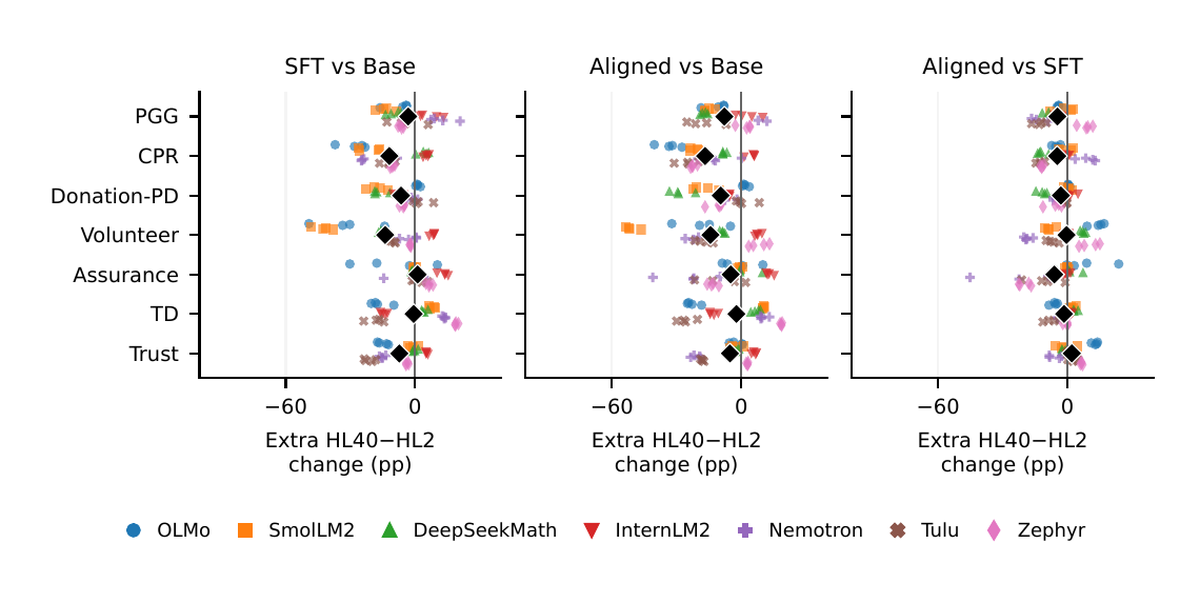
Liu and colleagues compare pretrained (Base), supervised fine-tuned (SFT) and preference- or reward-optimized (Aligned) checkpoints within seven released model lineages, 21 checkpoints in total, playing seven social dilemmas across 84 payoff configurations. Copies of each checkpoint self-play for 200 rounds with the visible history limited to the last 2 or 40 rounds. Averaging the six binary-action games equally within each lineage, expanding history changes cooperation by -1.17 points at Base (95% interval -4.79 to +2.45) but -8.11 at SFT (CI -13.16 to -3.05) and -10.93 at Aligned (CI -16.85 to -5.01). The amplification over Base is mostly present at SFT already (-6.93 points); the further SFT-to-Aligned difference (-2.82) has an interval spanning zero. Post-trained cooperation also falls more steeply as per-round cooperation costs rise, and a seven-stage Nemotron-Cascade case study shows a later instruction-following RL stage restoring cooperation levels while the history-related decline persists.
Assessment
Direct evidence that post-training evaluation has to include repeated interaction: alignment stages that improve one-shot behavior simultaneously deepen cooperation's sensitivity to visible history. For cooperation measurement, the checkpoint-stage comparison design is itself a useful template.
Catch-up: submitted October 16 under cs.GT, outside the three categories this digest polls daily; found through the daily OpenReview venue check (ICLR 2027 submission 62282) on November 13.
- Authors’ claims
Deliberating with two LLMs raises user accuracy; devil's advocates lower it
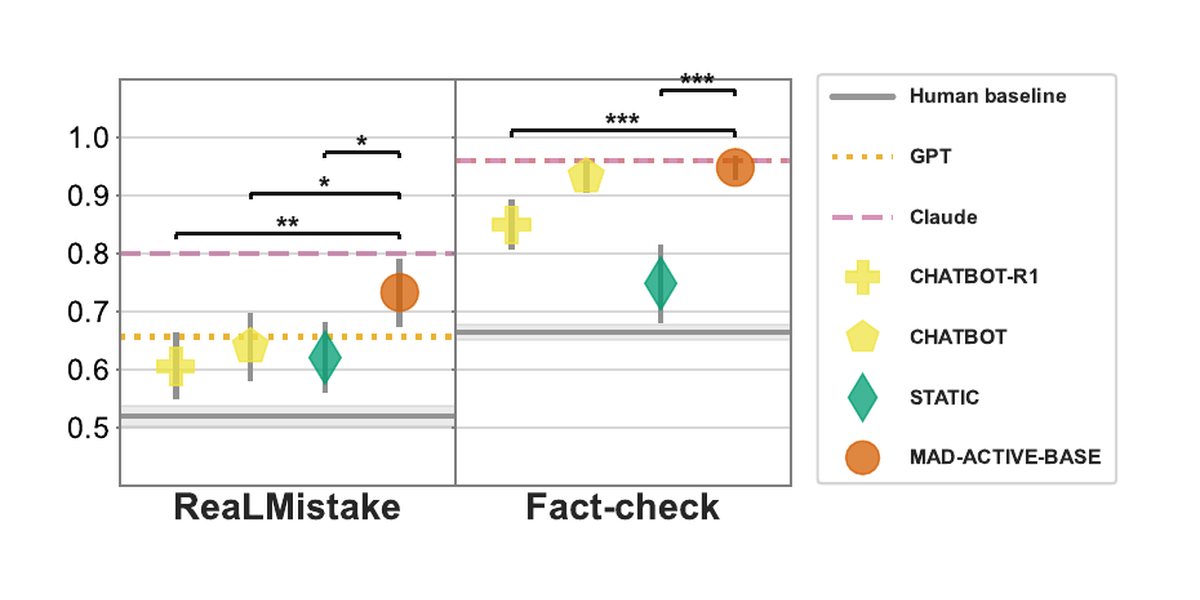
Tian and Yin run two Prolific studies (401 and 417 participants) in which users solve error-detection tasks while GPT-5.4 and Claude Sonnet 4.5 deliberate alongside them. On ReaLMistake, the MAD-Active-Base condition reaches 0.733 accuracy against 0.605 for a single-round chatbot (Chatbot-R1, p=0.007); on Fact-check, 0.948 against 0.849 (p<0.001). Assigning one model a devil's advocate persona lowers accuracy rather than raising it, and multi-round interaction emerges as the main driver of the gains; active participation helps on ReaLMistake at the cost of higher reported frustration.
Assessment
Human-in-the-loop deliberation is cooperation between people and agents, and this is a rare controlled measurement of it: structured multi-round debate with models improves human judgment, while the popular devil's advocate pattern backfires.
Submitted November 11; the arXiv web listings have not rolled since November 11, so this item was discovered through the arXiv API on November 13.
Also seen
- Authors’ claims
Token-level credit assignment for multi-agent communication
OPSD4MAS converts future multi-agent communication into fine-grained, token-level credit through on-policy self-distillation: an external model extracts facts and filters trajectory relations, then leave-one-out filtering measures target-token influence, addressing the coarse scalar-reward problem in reinforcement learning for LLM multi-agent systems.
Assessment
Credit assignment over communication is a core obstacle to training cooperative agents; worth watching once full results are digested.
Submitted November 12; the arXiv web listings have not rolled since November 11, so this item was discovered through the arXiv API on November 13.
- Authors’ claims
Economic institutions as a design space for artificial agents
A position paper arguing that multiagent research inherited its economic vocabulary (auctions, markets, prices, bargaining, matching) from human societies whose constraints, private minds, one-person persistence, learned-not-copied skills, engineered agents need not share. The authors sketch a wider, unmapped design space of institutions for artificial agents.
Assessment
A conceptual prompt to design agent economies around agent-native properties rather than copying human institutions.
Submitted November 11; the arXiv web listings have not rolled since November 11, so this item was discovered through the arXiv API on November 13.
- Authors’ claims
When does delegating to other LLMs actually help?
Purpose-built datasets with pre- and post-cutoff splits compare delegation modes for agentic search, asking when delegating to external tools and other LLMs improves performance, including on post-cutoff information the orchestrating model cannot resolve from its own knowledge.
Assessment
Delegation effectiveness is the orchestration question behind every multi-agent product; the pre/post-cutoff split is a clean way to isolate it.
Submitted November 12; the arXiv web listings have not rolled since November 11, so this item was discovered through the arXiv API on November 13.
Editorial synthesis
Today's cluster is about what cooperation measurements can see. DecArena scales decentralized evaluation to 100K tools with adversarial stress tests, the freight tournament separates match rate from actual payoff, and SwarmSafe-Delta adds the placebo control most swarm-risk studies skip. CoopShift supplies the sobering complement: the post-training stages that improve one-shot behavior deepen cooperation's sensitivity to visible history, so single-turn evaluation misses the failure mode.
Editorial interpretation of the cited sources.