
AI agent cooperation Instinct
Catch-up: reproducible simulations, causal credit, safe orchestration
A methodology-heavy catch-up while arXiv delays the Tuesday listing: one missed prompt line flips a published simulation, cooperative driving separates credit from blame, fleets learn alone and coordinate by transport, and orchestration gets a runtime gate.
- reproducibility
- social-simulation
- causal-attribution
- cooperative-marl
- runtime-verification
- orchestration
Evaluation
- Authors’ claims
One overlooked prompt line flips a published simulation result
Downes, Milletich and Hirst extend the ODD protocol, the de facto standard for describing agent-based models, with five backward-compatible documentation blocks for the components that determine LLM-agent behavior: prompt assembly, memory serialization, parsing and retry logic, grounded in the CoALA cognitive architecture. To show the gap matters, they run a multiverse analysis of a published LLM naming-game simulation, varying six specification choices a reimplementer must make. Variants that are defensible readings of the paper stay within statistical noise of their baseline reconstruction, but missing one instruction the paper states yet is easy to overlook, that the model answers as an outside observer rather than as a player, raises the share of runs settling on the convention agents individually favor from 0.35 to 1.00 and makes convergence three times faster, in a reimplementation that uses a different model from the original. A reconstruction-sufficiency review of 28 published LLM-agent simulations finds prompt construction and output parsing undetermined in 77% of cases, with no paper fully specifying its main LLM call.
Assessment
Simulation results are entering the cooperation literature fast, and this shows how fragile their reproducibility already is: the headline outcome of a published study flips on a single easily missed instruction. The five blocks are a concrete checklist for any group-simulation paper and for any benchmark built on one.
Submitted November 6; announced in the November 9 listing.
Coordination research
- Authors’ claims
Credit and blame, separated, make cooperative driving safer
Teng, Li and Huang present CARGO, a cooperative multi-agent reinforcement learning framework for on-ramp merging in mixed traffic that separates two questions attribution usually conflates: signed behavioral influence coupled with marginal team utility shapes cooperative reward, while responsibility is assigned from positive excess tail risk relative to a safe reference policy. A shared latent-context posterior and an action-conditioned response model estimate directed influence, with posterior uncertainty propagated into interaction-edge selection, and a diffusion-based mechanism translates responsibility into risk-reduction requirements inside a policy trust region. In highway-env experiments across three traffic densities, CARGO reduces crash rates by 14.16%, 52.91% and 56.23% under low, medium and high density relative to the strongest baseline for each metric, and raises high-density success from 18.67% to 31.00%, a relative gain of 66.04%; the authors note many high-density episodes end without collision yet without merging, so crash rate and success rate measure different things.
Assessment
Splitting credit assignment from blame assignment is a clean idea for cooperative MARL: influence alone does not identify team benefit, and cost alone does not identify avoidable risk. Both directions matter for evaluating cooperation quality, not just task success.
Submitted November 6; announced in the November 9 listing.
- Authors’ claims
Learn alone, coordinate by transport: a separation principle
Pezzetti, Lanzetti, Terpin, Dörfler and Ramponi study cooperative MARL where agents evolve under decoupled noisy dynamics but share a population objective, as in a mobility operator orchestrating a vehicle fleet. Formulating the problem over probability measures, they prove a separation principle that decouples learning a single-agent policy from coordinating the population, and build SALT on it: learn a target-conditioned single-agent policy with any standard RL algorithm, then coordinate agents via optimal transport. Because learning stays at the single-agent level, SALT scales to fleet sizes where MARL baselines become intractable and transfers without retraining to fleet sizes unseen during training, demonstrated on stochastic grid worlds and a vehicle-delivery experiment on the southern Manhattan road network where MARL baselines are computationally prohibitive.
Assessment
A principled decomposition with a practical payoff: if coordination can be handled by optimal transport over a learned single-agent policy, the joint state-action blowup that blocks most cooperative MARL disappears. The transfer-without-retraining property is exactly what fleet-scale deployment needs.
Submitted November 6; announced in the November 9 listing.
- Authors’ claims
Let the debate pick its channel, per task
Zeng and colleagues observe that multi-agent debate on multimodal tasks fixes how agents exchange evidence, usually text or graph, and that this choice alone moves both accuracy and token cost. Their AIM framework routes each debate to an interaction modality combination, adding task-dependent modality interaction beyond text and graph, with pruning rules that drop under-fused and over-fused combinations. Across visual, audio and video question-answering benchmarks, combining interaction modalities improves accuracy over the best single-modality baseline by up to 6.4%, and while the best fixed combination differs per benchmark, AIM performs best on all of them, adding up to 4.2% accuracy over the best fixed combination while reducing token cost by up to 53.4%.
Assessment
Communication channel as a learned or routed decision rather than a design constant: the same lesson as s3's learned when-to-talk, here applied to what-form-to-speak-in. The per-task variability of the best fixed channel is itself the finding.
Submitted November 6; announced in the November 9 listing.
Infrastructure
- Authors’ claims
Natural-language orchestration with a verifier in the loop
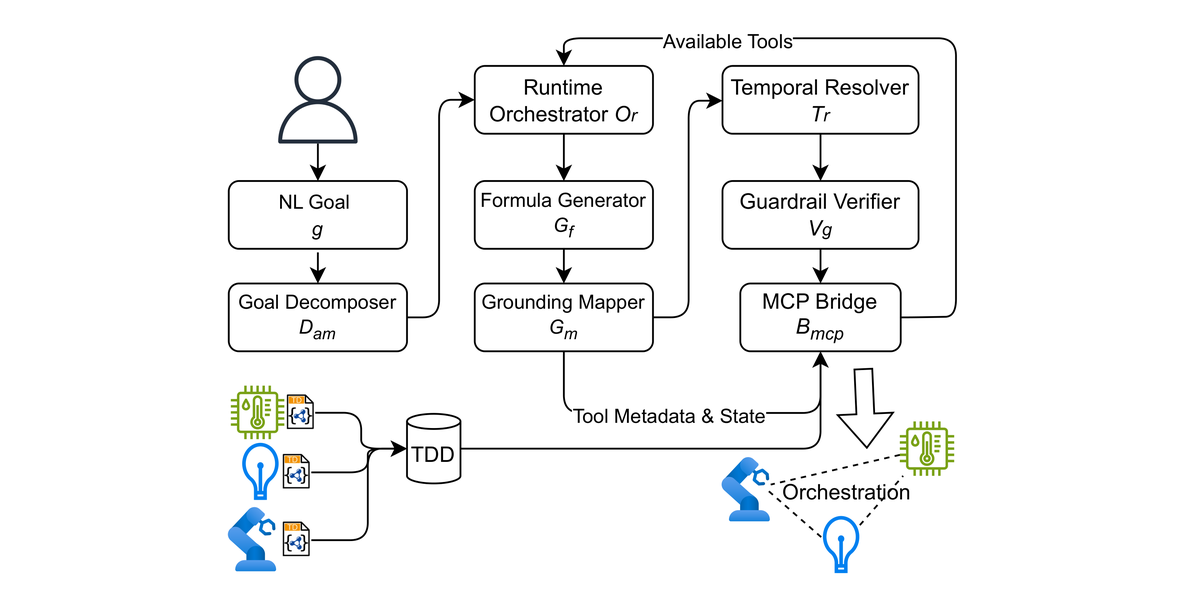
Ashfaq, Sadik, Warburton and colleagues present a reference architecture for orchestrating cyber-physical systems from natural-language intent without unconstrained LLM tool use: an intent is decomposed into atomic goals, each goal gets a runtime-checkable specification, specifications are grounded to device capabilities and state, and a guardrail verifier runs precondition evaluation plus SMT-based cross-rule consistency checks before a runtime orchestrator executes through an MCP bridge. In their prototype evaluation, SafeOrchestrate achieves 100% required-action accuracy on every task and 100% MCP Execution Similarity on all but one task, where it reaches 92%, while the unconstrained baseline degrades on multi-device, event-triggered and ordered tasks, with execution similarity falling to 13%. Event-absent controls verify the system does not act without triggers.
Assessment
The architecture pattern is the transferable part: specification generation, grounding, and a runtime gate that checks preconditions and rule consistency before execution. The MCP bridge makes it directly applicable to tool ecosystems beyond their testbed.
Submitted November 6; announced in the November 9 listing.
Also seen
- Authors’ claims
A planner coordinates specialist LLMs for meeting summaries
Sonali, Varshney and Ekbal present ReSUM, a modular multi-LLM framework for query-focused summarization of long meetings, coordinated by a planner that separates retrieval, evidence extraction and summary generation instead of compressing them into one pass, targeting the omission and hallucination risks of end-to-end approaches.
Assessment
Separating retrieval, evidence and generation under a planner is the reliable pattern for long-document tasks; meeting transcripts are a stress case because speaker dynamics defeat single-pass compression.
Submitted November 6; announced in the November 9 listing.
- Authors’ claims
Orchestrating memory, retrieval and intent for recommendation
Pitman de Castro, Silva, Kanno and colleagues propose a memory-aware multi-agent architecture for conversational recommendation in which LLMs act as orchestration layers coordinating intent refinement, query construction and interaction flow, so user intent can evolve across sessions instead of each session being treated in isolation.
Assessment
Cross-session intent is where single-session memory benchmarks stop; an orchestration treatment of evolving intent complements the recall-versus-use findings from the group-assistant benchmark covered November 8.
Submitted November 5; announced in the November 9 listing.
Editorial synthesis
Today's thread is trust in the machinery. A simulation's headline result can flip on one undocumented instruction, which makes specification standards a precondition for believing the literature. On the constructive side, cooperative systems get sharper accounting, credit separated from blame, learning separated from coordination, and execution separated from intent by a runtime check.
Editorial interpretation of the cited sources.