
AI agent cooperation Instinct
TeamGym, CrossProfile and the price of model handoffs
Two benchmarks price teamwork directly: distributing pivotal facts across teammates costs 22.9 points, and group memory fails by what it keeps. Model handoffs cut API costs 65.9 percent when timed right, and a live audit finds half of re-verifiable agent fix claims fail at the claimed location.
- team-decision-making
- agent-memory
- model-handoffs
- multi-agent-rl
- agent-interoperability
- agent-evaluation
Evaluation
- Authors’ claims
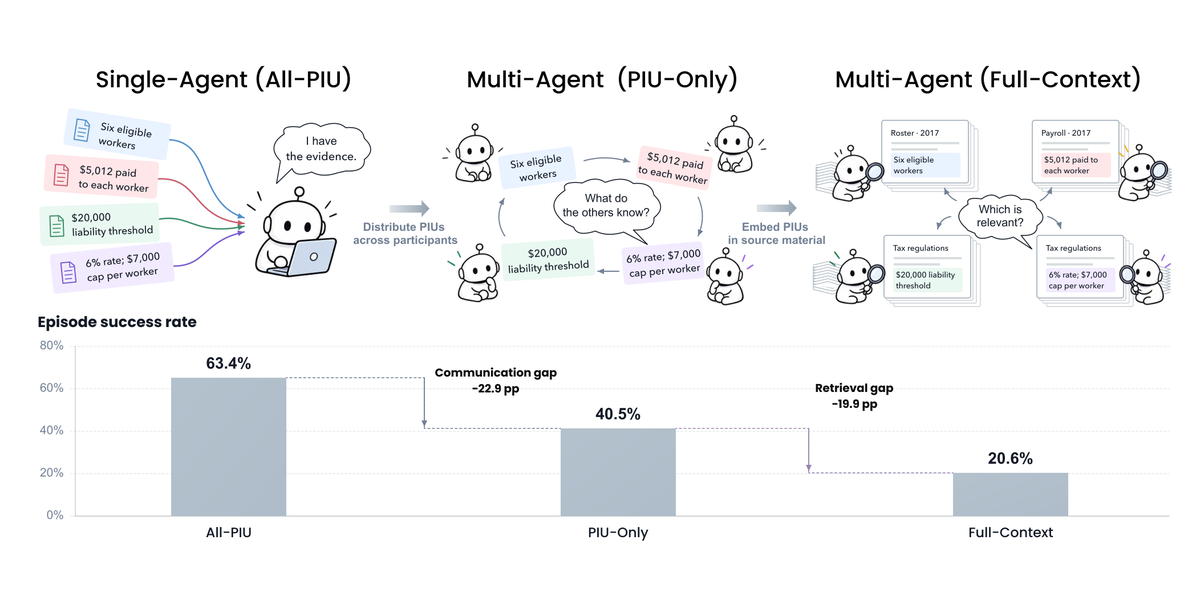
TeamGym: splitting facts across teammates costs 22.9 points before retrieval costs another 19.9
Park and colleagues report TeamGym, a gym that builds team decision problems from 12 source corpora across legal, finance, medical and software engineering domains, each distilled into a minimal set of pivotal facts that are individually necessary and jointly sufficient for the correct decision. Across 8 language models, handing every pivotal fact to one model succeeds on 63.4 percent of episodes; distributing the same facts across participants drops success to 40.5 percent, a 22.9 point communication gap, and embedding them in source material for participants to retrieve drops it to 20.6 percent, a further 19.9 point retrieval gap. Reinforcement learning on the team decision loss improves final-decision quality and induces emergent coordination in participation and speaker selection, though the gains are clear on validation episodes in the training domain and do not clearly transfer to a held-out corpus.
Assessment
A clean decomposition of why teams underperform one model with the same facts: communication failure and retrieval failure are measured separately, which makes the benchmark diagnostic rather than just a leaderboard.
- Authors’ claims
CrossProfile: group memory fails by what it keeps, not how it selects
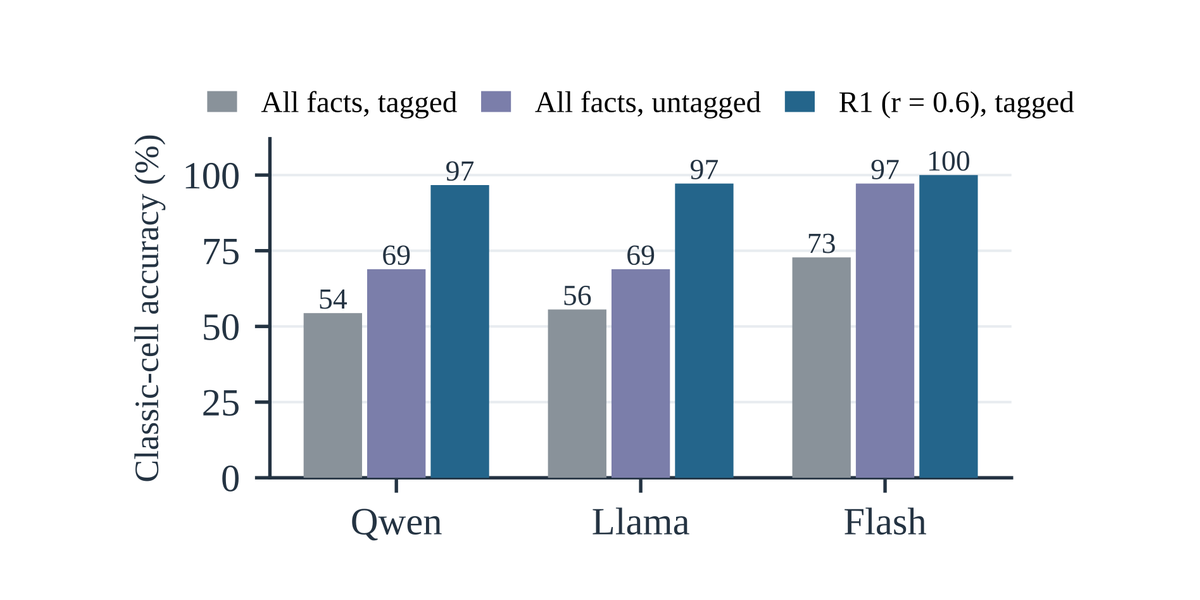
Imel and colleagues report CrossProfile, a diagnostic benchmark of 60 templates and 480 tasks in which the ownership of supporting, decoy and irrelevant facts is crossed while the fact text stays fixed. On hidden-profile decisions with Qwen2.5-7B, Llama-3.1-8B and two DeepSeek models, even a perfect relevance filter loses 23 to 31 points to rarest-first selection in the classic configuration because decoys are on topic, while rarest-first selection is no better than random selection on average. The decision model shows a social proof failure: removing the holder attribution tags, or reassigning them at random with line order fixed, raises accuracy by 13 to 24 points in the classic configuration. In natural discussions the evidence is lost before any memory acts: the complete transcript scores lower than no memory at all.
Assessment
The ownership crossing isolates a result most memory papers conflate: accuracy tracks the balance of evidence the memory keeps, not the policy that kept it, and attribution metadata actively misleads the reader model.
- Authors’ claims
- Catch-up item
PASS is a claim: half of re-verifiable agent fix claims fail at the claimed location
Zhenbing Lei and Chang Lei report a mechanical re-verification of 10 self-asserted code-level fix claims broadcast by a privileged coordination agent in AITRAP, a live multi-agent knowledge-tree platform with 19 agents. The claims come from 179 coordination broadcasts between August 31 and October 12, 2026, of which 28 carried structured fix assertions covering 18 distinct fix identifiers. File modification timestamps are consistent for 70 percent of claims, the claimed defensive pattern exists at the claimed identifier and call site for 60 percent (80 percent anywhere in the codebase), and 80 percent carry enough information for deterministic re-verification. Among the claims that do carry enough information, 50 percent fail the location check: the fix either does not exist at the claimed location or does not exist at all.
Assessment
A direct measurement of self-reported compliance in a running multi-agent system, and an argument that any audit layer built on PASS declarations needs independent mechanical checks.
- Authors’ claims
Asch conformity measured as a distribution shift, not a single answer
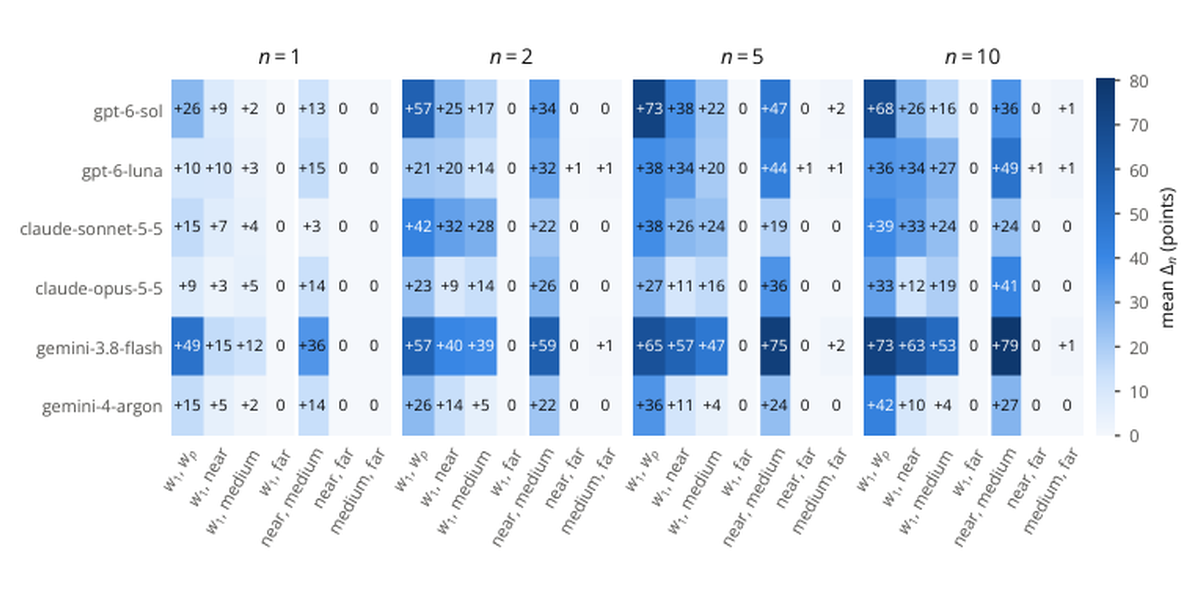
Rajasekaran and Vasileiou report a distributional version of the Asch conformity experiment: instead of sampling many questions once, they query each frontier model one hundred times per fill-in-the-blank sentence across ten sentences, build a distribution over the model's preferred words, then measure how the distribution shifts after a manufactured unanimous consensus of other participants who all choose the word the model preferred less. All six tested models (gpt-6-sol, gpt-6-luna, claude-sonnet-5-5, claude-opus-5-5, gemini-3.8-flash and gemini-4-argon) conform, most strongly when the consensus answer is another of the model's own preferred words and considerably even toward words the model never produced on its own. Per-question tests find a significant shift for most question types, and the shift grows with the number of other participants.
Assessment
Repeating one question instead of sampling many turns conformity into a measured distribution shift, which separates genuine opinion change from sampling noise and shows the degree of conformity depends on what the consensus says.
Coordination research
- Authors’ claims
AgentBaton: one well-timed handoff to a cheaper model cuts API cost by 65.9 percent
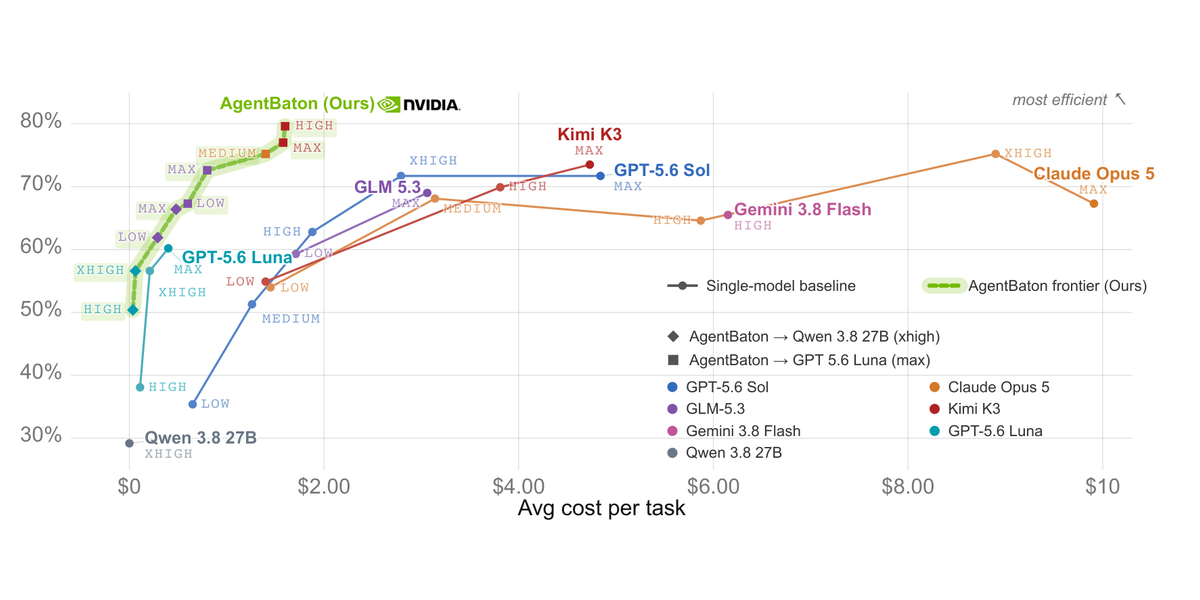
Li and colleagues report a systematic study of one-time model handoffs in long-horizon agentic tasks, where a receiving model inherits the workspace and continues. Handoffs from an efficient model to a capable one generally underperform capable-only execution with limited or no cost reduction, while handoffs from capable to efficient at suitable stages of task progress largely preserve or even improve accuracy at substantially lower cost. Their lightweight detector, AgentBaton, learns when to hand off from recurring patterns in task progress and, across 11 model pairs on DeepSWE v1.1 and Terminal-Bench 2.1, reduces API costs by 65.9 percent on average while largely preserving task accuracy, with accuracy gains of up to 8.8 percentage points over capable-only execution.
Assessment
A practical counterpart to handoff-quality benchmarks: this work prices when to hand off, and the direction asymmetry (capable first, cheaper later) is a simple rule that needs no training to apply.
- Authors’ claims
Evolving Agent Teams: restructuring the team escapes local optima on expert GPU kernels
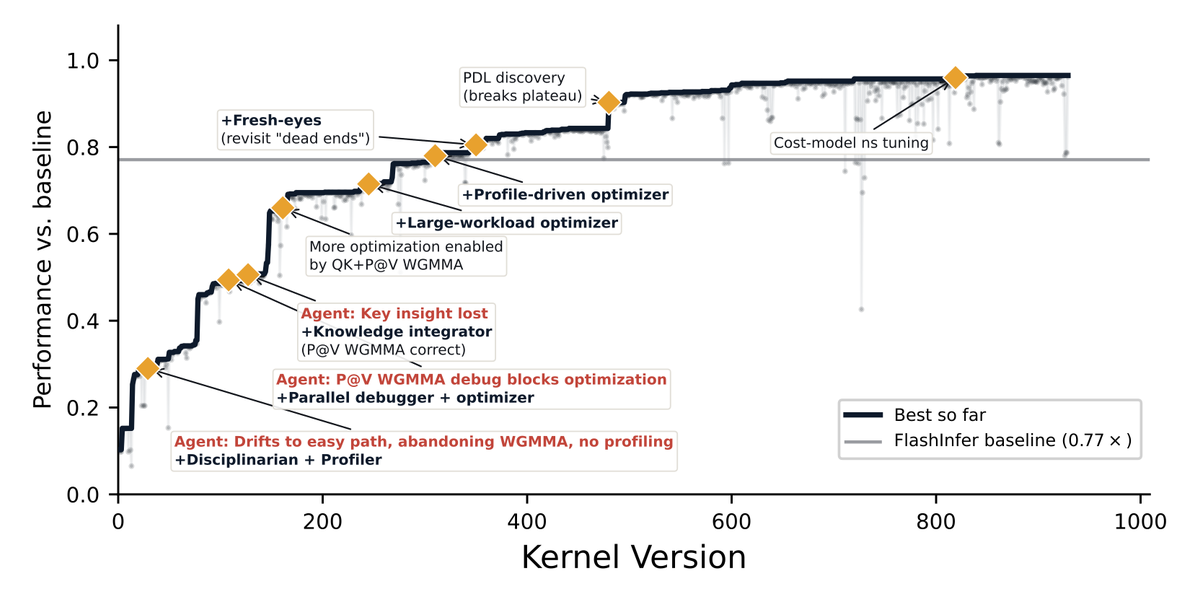
Cao and colleagues report Evolving Agent Teams, a framework in which a central supervisor diagnoses each local optimum and restructures the agent team, grounded in a persistent file system of accumulated experience. On the MLA decode kernel, single coding agents plateau far below expert performance (Codex 5.5 xHigh reaches 28 percent of the expert baseline and a static four-role team 55 percent), while the evolving team explores over 100 team configurations and, with an extended token budget, reaches a 1.2x mean speedup over the production FlashInfer kernel from scratch, winning on 36 of 47 FlashInfer-Bench workloads and staying within 0.86 to 0.99x on the other 11. The same framework reaches 3.01x over vLLM on KDA prefill on an AMD MI350X, 3.44x over FlashKDA on a B200, and 62.1 versus the best leaderboard entry's 55.3 on held-out RoboDojo robot manipulation seeds.
Assessment
Evidence that organization, not only model strength, binds open-ended optimization: the supervisor's restructuring decisions track the phases of expert kernel work, from correctness to profiling to redesign.
- Authors’ claims
TANDEM: a gated second read of the centralized critic closes the execution gap
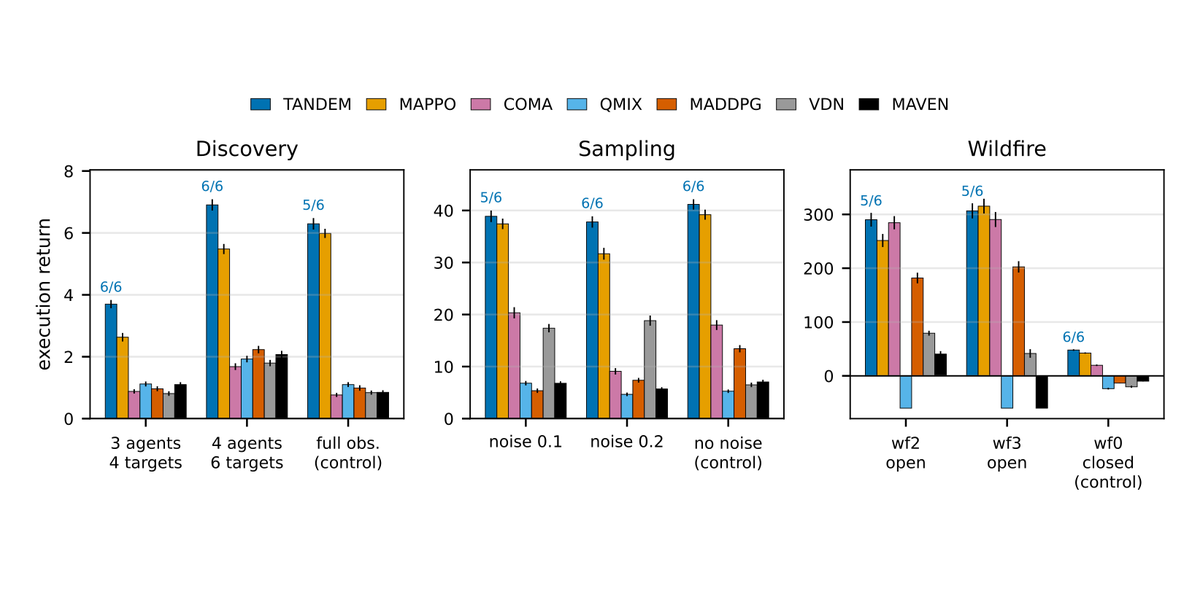
Saleh Abadi and colleagues report TANDEM, a cooperative multi-agent reinforcement learning scheme for the information gap between centralized training and decentralized execution. One centralized critic is read two ways each step, from the global state and from the acting agent's own information, and a parameter-free gate mixes the two advantage estimates per agent and per step, reinstating the centralized read exactly where the local view is misleading while a shared target pulls the two reads together over training. Across three domains that each isolate one form of the gap (discovery for partial observability, sampling for observation noise and wildfire suppression for openness), TANDEM posts the best execution return on eight of nine setups against six CTDE baselines and is never significantly worse, with the gate contributing most under openness. Returns are measured over 100 unseen episodes with the critic removed.
Assessment
A clean design point: instead of distilling the centralized critic once, agents rehearse acting without it while correction is still possible, and the per-agent gate makes the withdrawal adaptive rather than scheduled.
Infrastructure
- Authors’ claims
Future-proof testing: compatibility with a published seed guarantees compatibility with each other
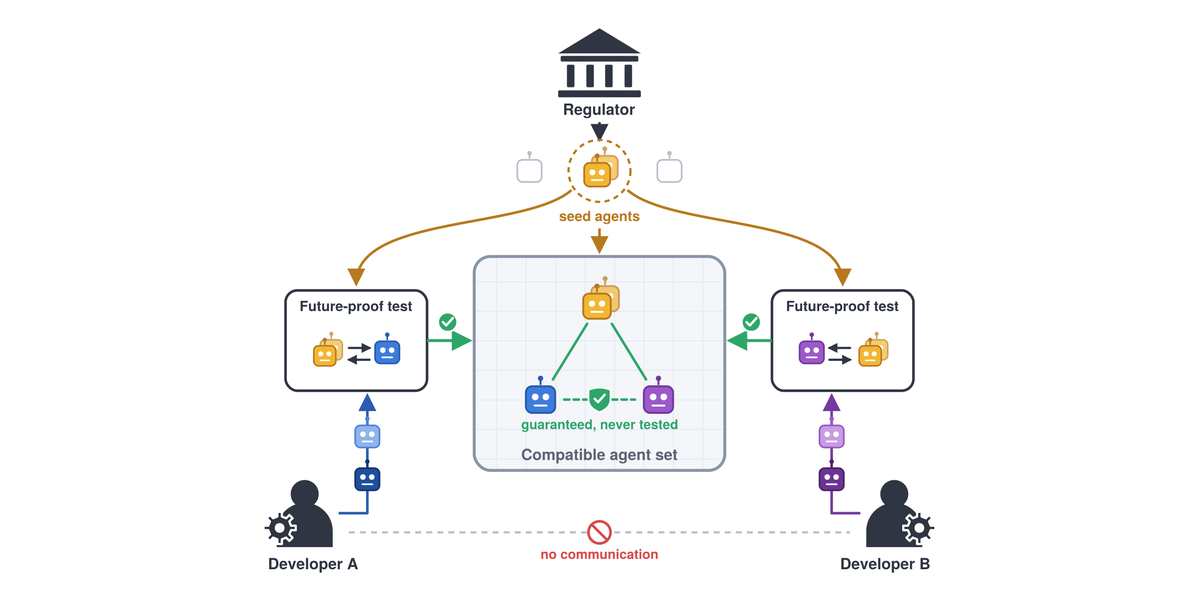
Li, Fiaschi, Censi and Frazzoli report a bi-level testing structure for independently developed agents: a regulator publishes seed agents, and each developer tests its own agent against the seed alone, with no communication between developers. They formalize compatibility for general multi-agent systems, show that it is not implied by seed-compatibility alone, and characterize the future-proof agents as the closure of the seed, which grows monotonically as the seed grows. Case studies on a single-lane vehicle chain under emergency braking and a warehouse grid world with 38 self-compatible agents show how the largest guaranteed-compatible sets come out (five left-yielding and four right-yielding agents in the warehouse).
Assessment
A regulator-shaped answer to a real deployment constraint: confidential agent designs cannot be jointly tested in advance, and seed-relative testing yields a compositional guarantee without a central specification of every interaction.
- Authors’ claims
EREBOTS 4.0: a composable neuro-symbolic assistant framework passes 97 A2A compatibility checks
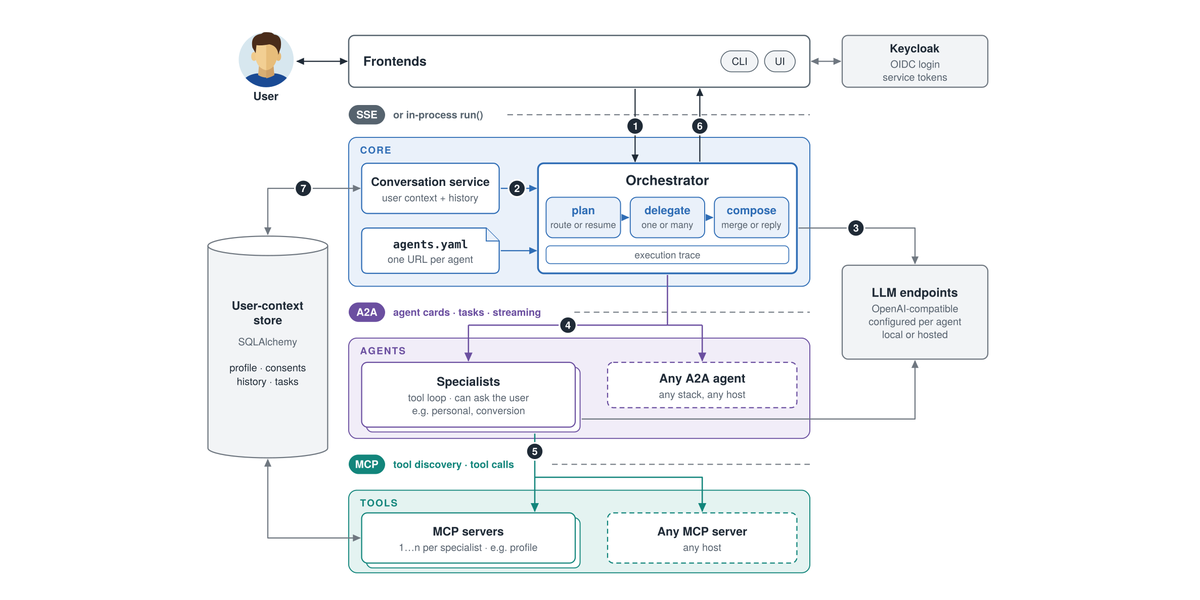
Pacioni and colleagues report EREBOTS 4.0, a framework for conversational assistants that pairs language models with deterministic tools and explicit protocols. An orchestrator plans, delegates to A2A agents and composes replies; new agents, local or remote, are added by listing a URL in a configuration file; MCP servers provide tool discovery and calls; and the framework manages identity, consent-flagged user context, task states and traces. Its A2A server passed 97 tracked requirements in the official A2A Technology Compatibility Kit with no failures.
Assessment
An engineering datapoint rather than new science: protocol conformance is becoming checkable, and a clean compatibility-kit pass is the kind of evidence interoperability claims should carry.
Editorial synthesis
Today's papers measure the seams between agents rather than the agents themselves. Teams lose a third of their success the moment facts are split across members, memory heuristics cannot rescue the wrong evidence balance, and one well-timed handoff beats constant capability. The infrastructure work supplies the complementary guarantees: seed agents make compatibility compositional, and protocol conformance becomes testable.
Editorial interpretation of the cited sources.