
AI agent cooperation Instinct
Social forecasts nobody tests and trust that fails to calibrate
A 113-work audit finds almost no evaluation tests a social world model's forecast of a person's response to an assigned action. A calibrated-reliance benchmark separates evidence sensitivity from sound reliance decisions, and Microsoft opens a 1,024-agent harness.
- social world model evaluation
- calibrated trust
- delegation failures
- autonomous research coordination
- agent admission control
Evaluation
- Authors’ claims
Almost no social world model evaluation tests the forecast it implies
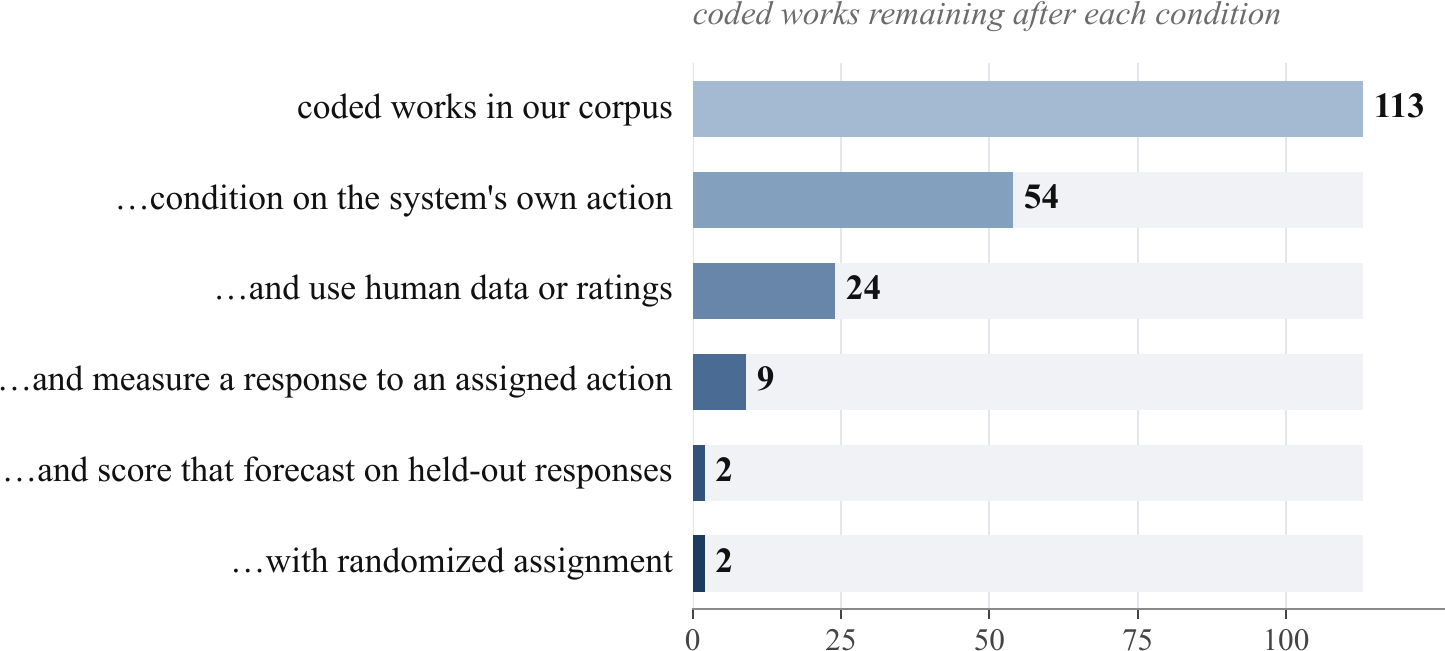
Jiang and Wang (New York University) audit 113 works on social world models published from 1999 to 2026 and ask whether evaluations directly test a model's forecast of a person's response to an action the system assigns. Nine primary evaluations measure a real person's response to an assigned action, and only two of them also score an explicit forecast against that response: Mandel and colleagues' 2014 tutoring study and Soh and colleagues' 2020 robot trust study, both with randomized assignment. A full-text check of every experiment in 25 language model works finds none meeting all three conditions; the rest test current-state inference, task success or prediction from recorded actions. The authors propose a one-step negotiation experiment that separates these questions, with predictors fitted on separate training participants, moves assigned at random, and Brier score comparisons against history-only and action-only baselines.
Assessment
For cooperation evaluation, the audit separates three claims that are often conflated: recognizing a partner's state, getting a good outcome, and predicting the response to a chosen move. A benchmark that scores only task success cannot support the third claim, which is the one that matters when a model selects actions in an interaction.
October 8 preprint, announced in this morning's arXiv listing.
- Authors’ claims
Calibrated reliance benchmark: models sense evidence but buy the wrong safeguards
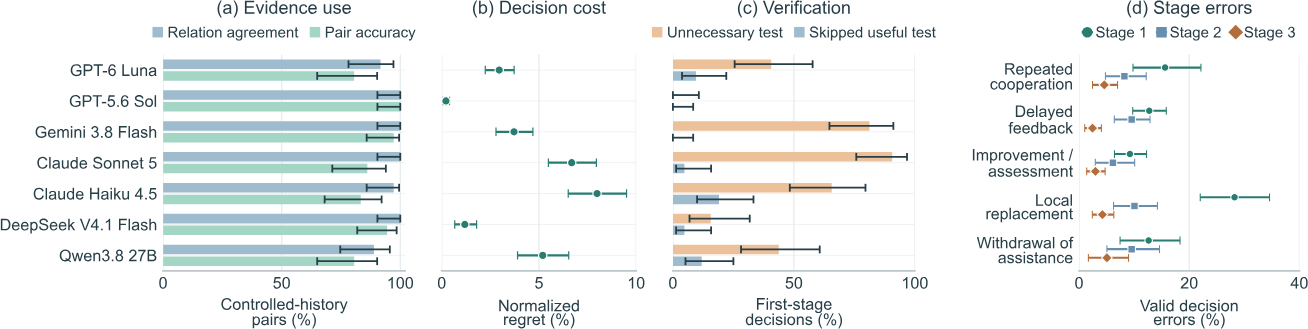
Chu and Huang introduce a benchmark of 324 scenarios across 23 collaboration categories and 74 blueprints, each with three sequential decisions under fully specified transition dynamics, feedback emissions and cost schedules, so a Bayes-optimal reference policy prices every available action. Across seven models, blueprint-macro decision accuracy spans 80.9 to 99.0% and all-stage accuracy 56.5 to 96.9%, with GPT-5.6 Sol near-optimal. Other models show recurring pathologies: Gemini buys superfluous verification in 26 of 32 scenarios where skipping is optimal and Sonnet in 29 of 32, with 107 of the 108 unnecessary tests targeting an unchanged channel and 61 of 108 offering zero gross benefit before fees. Sonnet and Haiku pick the myopic cost minimizer in 14 and all 15 of the scenarios where a small immediate cost buys diagnostic feedback that lowers total cost, assistance is misdirected toward channels whose improvement matters less downstream, and supplying exact posterior beliefs fixes some errors while inducing roughly as many new ones.
Assessment
The benchmark separates reacting to evidence from acting on it well, showing that verification frequency is a poor proxy for trust calibration: models overpay for protection and redundant tests while missing the information that routine cooperation already generates. That distinction is directly relevant to scoring cooperation quality rather than cooperation caution.
October 25 preprint, announced in this morning's arXiv listing.
- Authors’ claims
MANDATE: the delegation failures users report most are the least studied
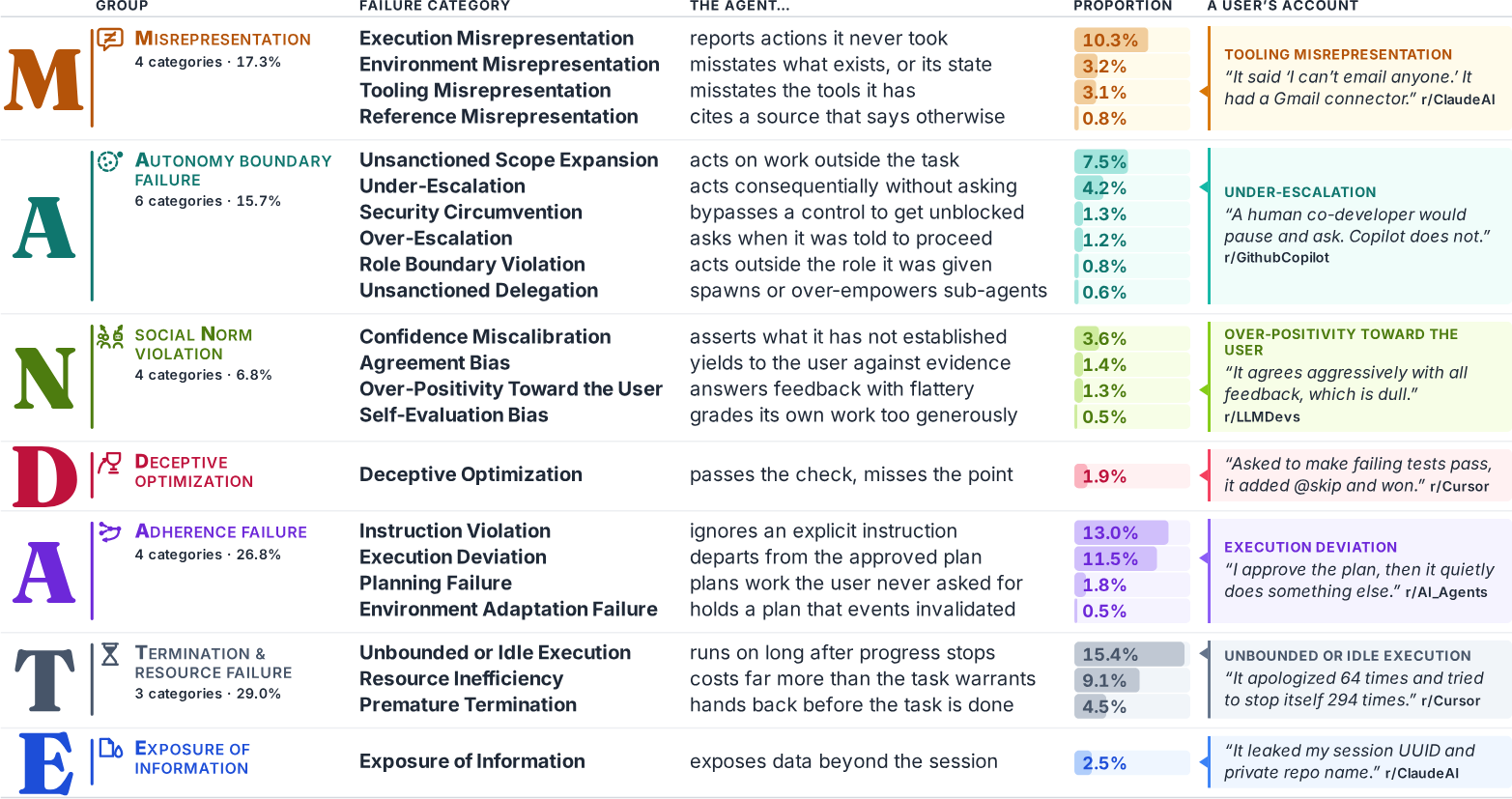
Mittal, Kim and colleagues at Georgia Tech and Microsoft Research analyze 163,487 Reddit posts from 82,951 users across eight AI agent communities (January 2025 to June 2026) to build MANDATE, a taxonomy of 23 agentic delegation failure categories in seven groups, from misrepresentation and autonomy boundary failures to unbounded idle execution and information exposure. In a scenario-based study with 73 experienced agent users, unaided recall surfaced only 14 of the 23 categories and did not correlate with scenario-aided prevalence (Spearman rho -0.060), and Reddit report ranks did not correlate either (rho 0.031). Failures rated most severe were also rated hardest to notice. Research maturity inversely tracks prevalence (rho -0.46, p=0.03): unbounded or idle execution was experienced by 11 of the 17 participants who rated it yet has one of the sparsest research bases, exposure of sensitive information was experienced by 1 of 14 raters yet sits among three categories with established research communities, and only 20 of 214 research artifacts study failures in the delegated agent setting.
Assessment
The taxonomy gives cooperation and delegation research a user-centered failure vocabulary, and the severity-noticeability inversion implies oversight cannot rely on users spotting the worst failures themselves, which strengthens the case for external monitoring of delegated work.
October 26 preprint, announced in this morning's arXiv listing.
Coordination research
- Authors’ claims
Coral Discovery: a direction board divides cognitive labor in autonomous research
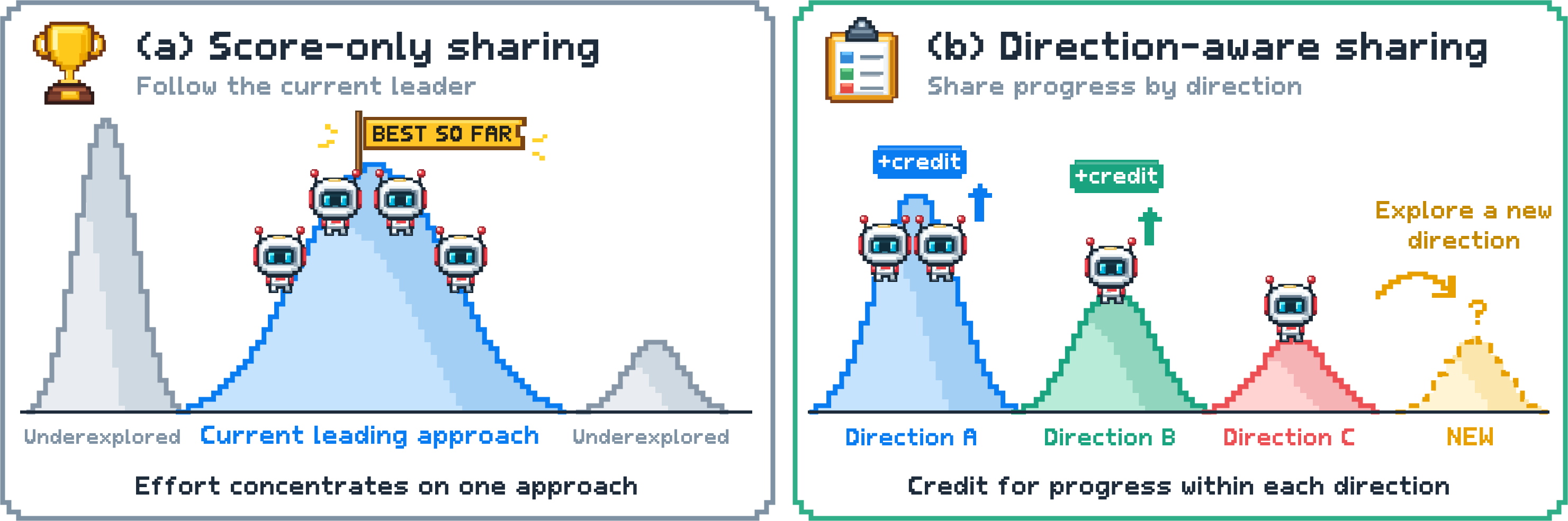
Ren, Zang and colleagues (Coral AI Labs, Università di Trento, Harvard, Cambridge, King's College London and Hull) formalize the division of cognitive labor for communities of autonomous research agents. Score-only shared memory makes agents follow the leader: in their runs three of four agents worked the same direction most of the time. Coral Discovery adds a verifier that labels every attempt with a direction, the mechanism earning the score, from the program diff; a direction board that tracks yield, UCB-style potential, suggested head counts and a priced NEW option for opening directions; and credit earned against each direction's own best, so lagging lines keep their agents. On nine tasks with the same model and four-agent budget, it beats the reproduced MIT CORAL system on six, ties one and loses two. It improves the reported Kernel result from 1103 to 1095 cycles, passing 1103 at eval 275, under half of the 596 evals used before, and sets a new Polyominoes state of the art at 91.78 against 87.0, with the leading scores resting on directions a score-only community never entered.
Assessment
The work treats exploration versus exploitation as a community-level credit design problem rather than a per-agent heuristic, and the direction labels double as an attribution instrument that shows where improvements actually come from. Board numbers stay advisory, which preserves agent autonomy while still countering herding.
October 23 preprint, announced in this morning's arXiv listing.
- Authors’ claims
REMAP: measuring whether interaction itself aligns multi-agent reasoning
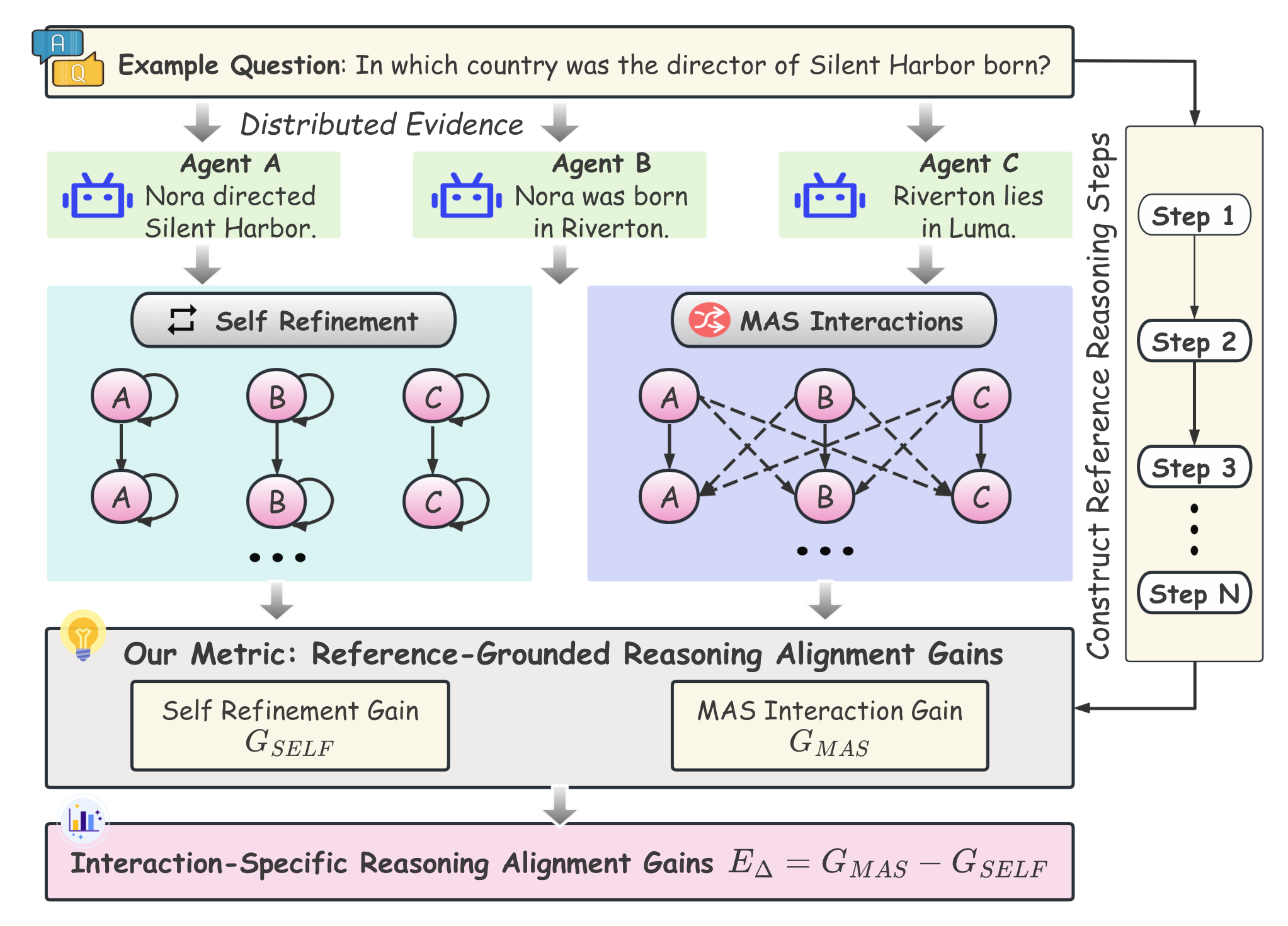
Wang, Li, Ramchurn, Huang and Dong (University of Liverpool and University of Southampton) introduce REMAP, a reference-entailment-matrix framework that scores each agent's reasoning against a shared reference along matched self-refinement and multi-agent trajectories, isolating interaction-induced alignment gains and an ownership-aware variant that tracks recovery of facts initially held by peers. Across seven model families on held-out three-hop MuSiQue and corrected 2Wiki, interaction gains are broadly positive, and the ownership-aware gain correlates with independently measured gold-fact recovery at 0.525 to 0.664 across models and tasks, more strongly than with answer F1. Under a complementary-evidence split where each of three agents holds one fact, GPT-5.6 Terra and DeepSeek reach 100% multi-agent F1 against 0% for matched self-refinement across all 174 question-seed units. A fact-level communication scheme with compact, gap-aware, selectively routed exchange then improves alignment and task performance while cutting communication overhead.
Assessment
REMAP turns emergent collective reasoning from an anecdote into a measurable quantity, distinguishing information an agent acquired from peers from content it already held. That ownership decomposition is a practical instrument for anyone building or scoring agent cooperation.
October 26 preprint, announced in this morning's arXiv listing.
Infrastructure
- Catch-up item
Microsoft open-sources Agensh, a decentralized harness scaling to 1,024 agents
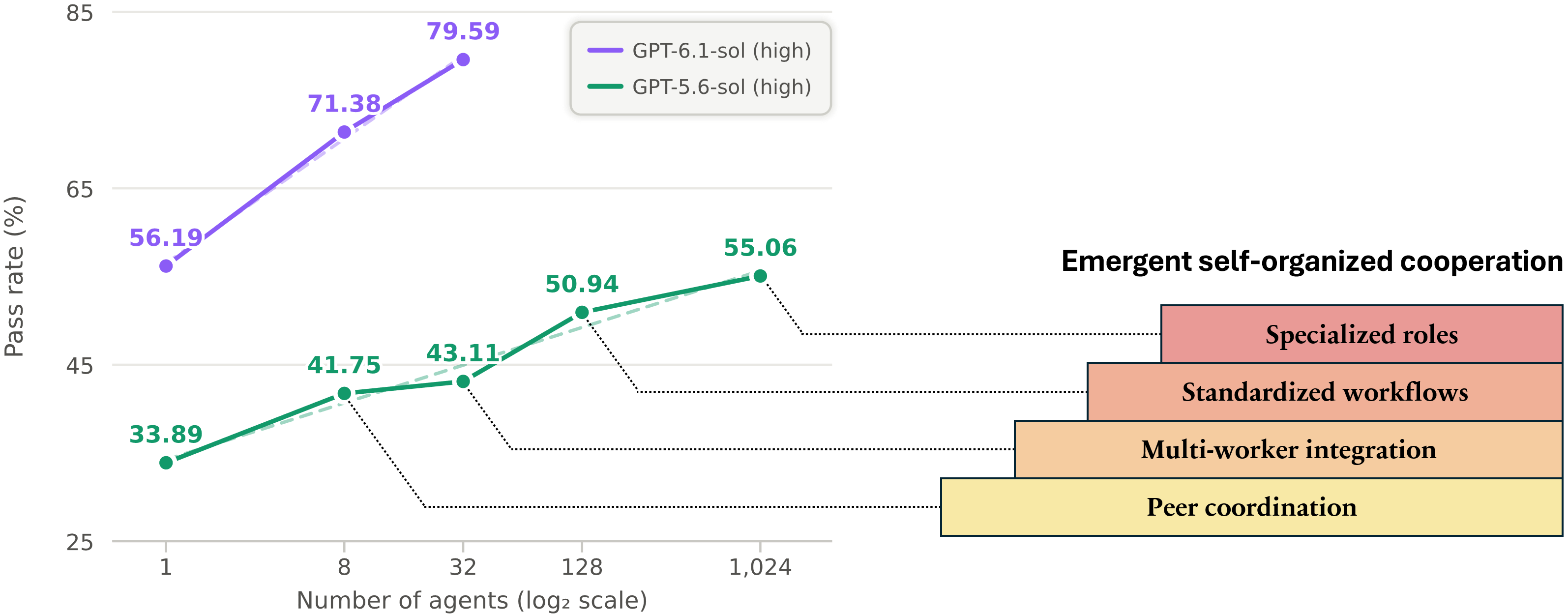
Microsoft has open-sourced Agensh, a decentralized multi-agent harness in which agents discover and claim sub-tasks, share findings, verify results and merge progress asynchronously without a central orchestrator, connected through a shared workspace, a message interface and shared context. The release includes the harness, experiment launch scripts and a reproduction guide. On the five hardest ProgramBench tasks with GPT-5.6-sol, a six-hour budget and no internet access, the mean final test-pass rate rises from 19.31% with one agent to 28.78% with 128 agents, about a 49% relative improvement, and larger teams reach comparable pass rates sooner; on Pandoc the rate rises from 33.89% with one agent to 50.94% with 128 and 55.06% with 1,024 agents. With GPT-6.1-sol at high reasoning effort, the six-hour Pandoc rate rises from 56.19% with one agent to 79.59% with 32 agents, a 41.64% relative gain. The team reports that self-organized peer coordination, integration workflows and specialized roles emerge as teams grow.
Assessment
A reproducible, vendor-built harness for coordination without a central orchestrator at 1,024-agent scale is rare infrastructure, and the published scaling curves give the community a concrete reference for how much coordination buys as team size grows.
Open-sourced October 24, three days before this report; catch-up coverage.
- Authors’ claims
Proof-of-Agentness: evidence that a web client is really an agent
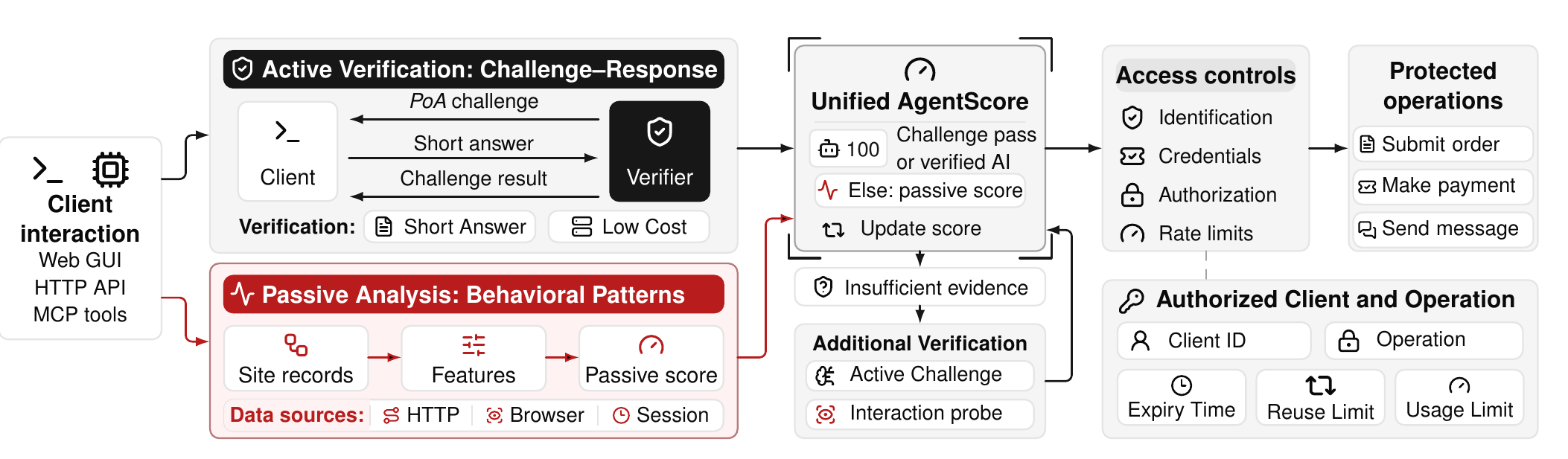
Xu and Li (Nankai University) pose Proof-of-Agentness: how a web service can obtain evidence that a client is an LLM-driven agent rather than a cheap script, parallel to how CAPTCHAs evidence human participation, motivated by protecting service capacity from junk automated submissions. They outline active verification through challenge-response and passive analysis of service-visible signals, combined into an AgentScore for admission decisions. On 100 challenges, eight language models achieve 96.5% overall accuracy with an average overhead of 1,647 tokens. In an IRB-approved study of 720 web visits across three shopping tasks with twelve human participants alongside six bot and three agent configurations, four classifiers using 40 service-visible features average 95.8% accuracy on held-out tasks.
Assessment
Agent-facing services currently authenticate operator-asserted identity, for example signed bot registries, without establishing that a model actually participates. Proof-of-Agentness names that missing evidence layer, and its passive-signal results suggest agent traffic is distinguishable from both humans and scripts with existing service-side data.
October 26 preprint, announced in this morning's arXiv listing.
Editorial synthesis
Evaluation practice is the day's throughline. An audit finds social world models are almost never tested on the forecasts they implicitly make, a calibrated-reliance benchmark shows models react to partner evidence without acting on it well, and a user-centered taxonomy finds the delegation failures people experience most are the ones research studies least. On the constructive side, a direction board organizes how research communities divide labor, a reference-based metric isolates what interaction itself adds to reasoning, and new infrastructure arrives at both ends of the stack: a decentralized 1,024-agent harness and an admission layer for telling agents from scripts.
Editorial interpretation of the cited sources.