
AI agent cooperation Instinct
PITCH's early interruptions, tipping networks and corrupted trust
PITCH shows proactive agents chime in too early, with ideal-turn accuracy collapsing once they must commit in real time. Network topology changes both consensus speed and how easily LLM populations tip, and corrupted transcripts hide how well agents actually choose.
- proactive timing benchmark
- network consensus dynamics
- corrupted communication
- agent governance records
Evaluation
- Authors’ claims
- Catch-up item
PITCH: proactive agents chime in too early when they must commit in real time
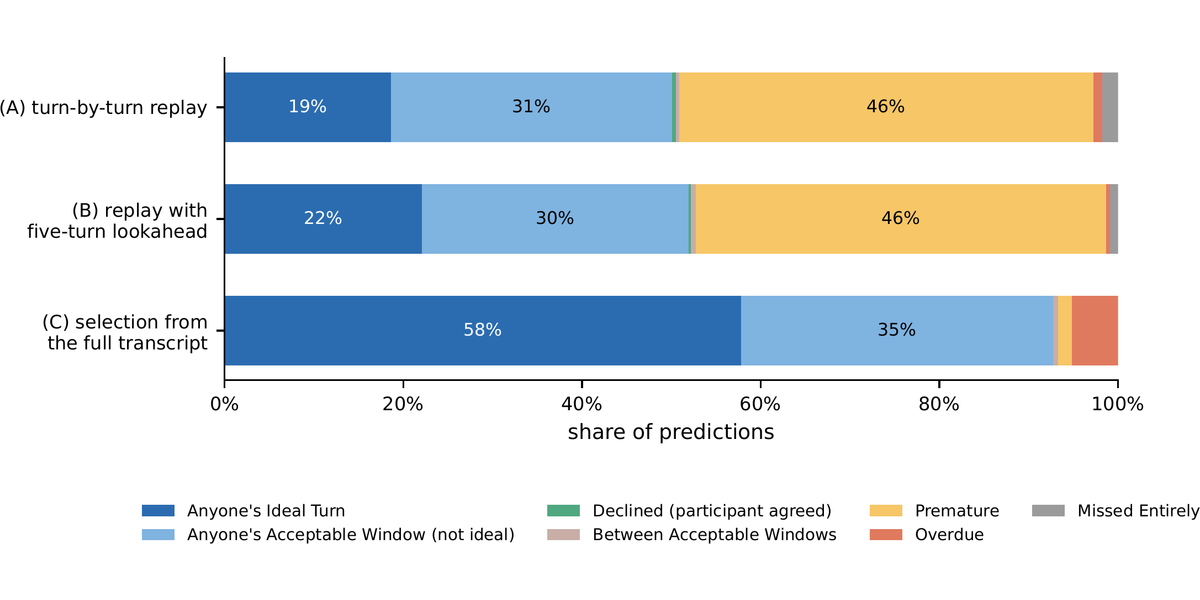
Wang, Yu and Zhou introduce PITCH, to their knowledge the first benchmark with large-scale human judgments of proactive agent timing, collected from participants inside the same unscripted multi-party conversations they took part in. The corpus holds 384 candidate contributions and 1,091 judgments from 89 participants across 35 conversations, each marking an ideal turn, an acceptable window, or that a contribution should not appear. Across 15 models in 28 configurations, models place contributions well when given the entire conversation history, but when they must commit without knowing what follows, ideal-turn accuracy falls from 57.8% to 19.0%, and 46.4% of predictions land before any annotator's acceptable window opens, against 1.0% that land after every window closes.
Assessment
Timing is isolated from content here, which makes PITCH a direct measure of a cooperation quality that end-task scores never see: whether an agent speaks at the right moment.
October 19 preprint, six days before this report; catch-up coverage.
- Authors’ claims
- Catch-up item
T1-Bench: interconnected long-horizon scenarios trip even frontier agents
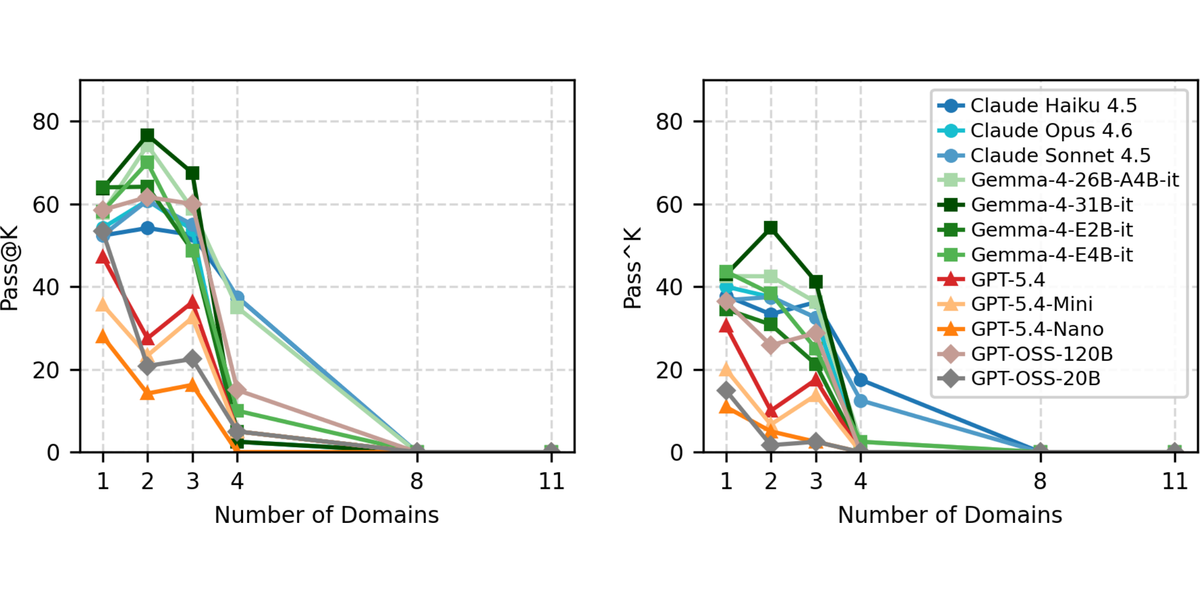
Capital One's science team presents T1-Bench, an EMNLP benchmark of realistic multi-domain environments with interconnected scenarios that require reasoning over prior customer interactions and historical context. The release includes a reproducible evaluation framework combining automatic metrics, fine-grained behavioral analysis and LLM-as-a-judge assessment. Benchmarking proprietary and open-weight models, the team reports that even state-of-the-art systems struggle with long-horizon reasoning, context retention and reliable decision-making in interconnected environments. Both benchmark and framework are released for reuse.
Assessment
The move that matters is temporal coupling between scenarios, which is where deployed assistants actually fail, rather than another static task list.
- T1-Bench: Benchmarking multi-scenario agents in large-scale real-world domains (Capital One Science) —
Capital One's science site dates this EMNLP publication October 24. The same paper has been public as an arXiv preprint (2606.11070) since June 9, 2026, so this report covers the conference version of months-old work.
Coordination research
- Authors’ claims
- Catch-up item
Network topology decides how fast LLM populations agree and how easily they tip
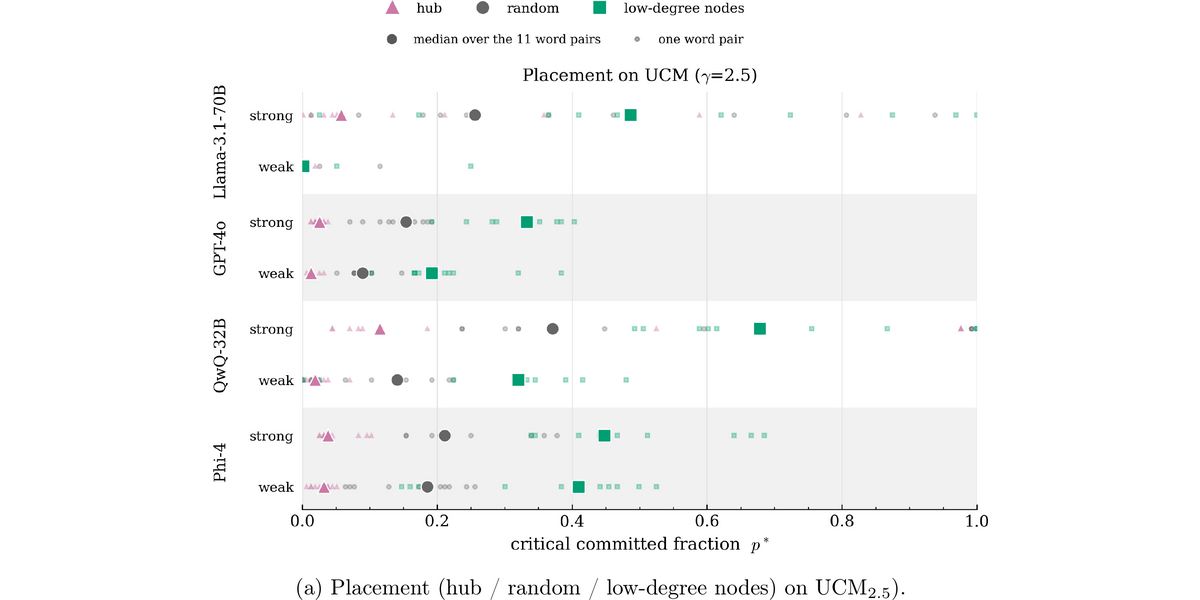
Passaro, Flint and Pastor-Satorras place policies extracted from four LLMs onto fully connected, random regular and heterogeneous networks of 1,000 to 100,000 agents playing the naming game. Topology changes how quickly consensus emerges, sometimes whether it emerges at all, and occasionally which convention wins: the sparsest networks slow consensus up to twelvefold, yet by preserving correlations between persistent neighbours they restore consensus in cases that fail to converge under well-mixed interactions. Committed-agent attacks are cheapest against hubs, then random placement, then low-degree nodes, with median critical masses of 3%, 16% and 35% on the most heterogeneous topology, so targeting hubs needs one-sixth as many committed agents as random placement. For most models, networked populations tip more easily than well-mixed ones.
Assessment
Well-mixed robustness estimates can overstate the safety of deployed agent populations, which turns who interacts with whom into a measurable safety variable rather than a modeling convenience.
October 22 preprint, announced October 23, two days before this report; catch-up coverage.
- Authors’ claims
Corrupted transcripts quietly break Stag Hunt cooperation while agents keep choosing well
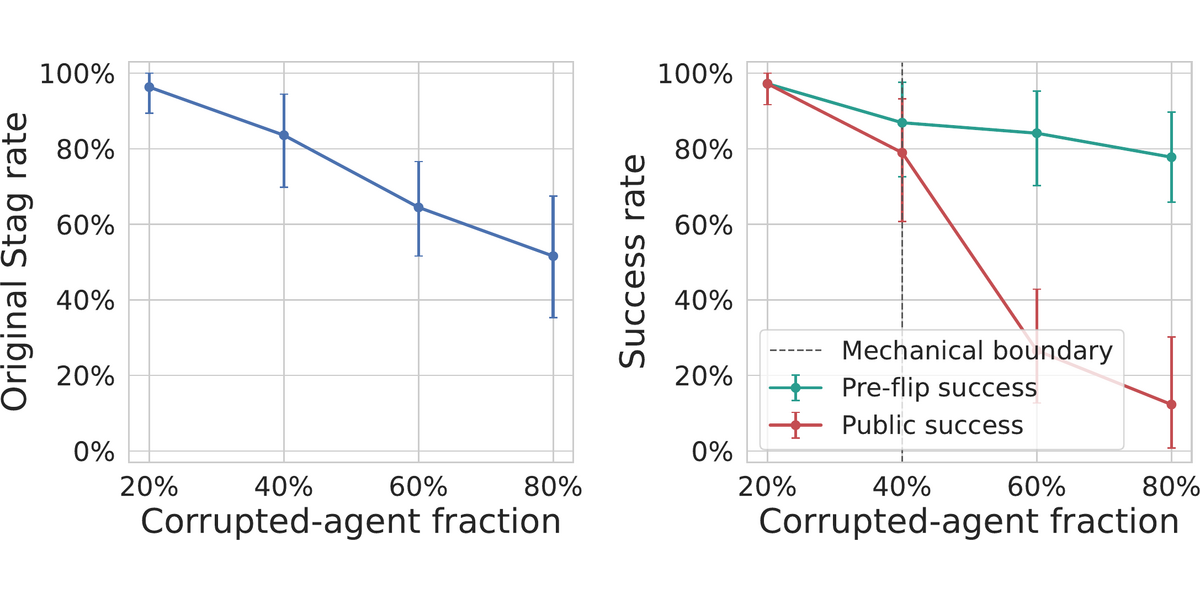
Liu, Dalton and colleagues run iterated N-player Stag Hunt games with homogeneous LLM groups under controlled programmatic action inversion that rewrites both the public transcript and the actions used for execution. Across group sizes, coordination thresholds, corruption levels and seven LLMs, honest agents' pre-flip Stag choices decline as corruption rises, but the collapse in public success is mostly mechanical: in the focal five-player, threshold-three setting, pre-flip success holds at 78% under 80% corruption while public success falls to 12%. Honest choices track the public history available at decision time, particularly under high corruption, and three threshold-style public-report benchmarks show action-match rates close to the LLM agents.
Assessment
Separating original choices, public actions and executed outcomes is an evaluation lesson for any multi-agent robustness claim, because transcript-based scoring can predictably misstate how well agents actually cooperate.
The ACL Anthology lists October 2026 without a day. The exact publication date is unverified; the REALM workshop session is October 29.
Infrastructure
- Authors’ claims
- Catch-up item
Contestable governance: agents argue, stewards decide, the record keeps both
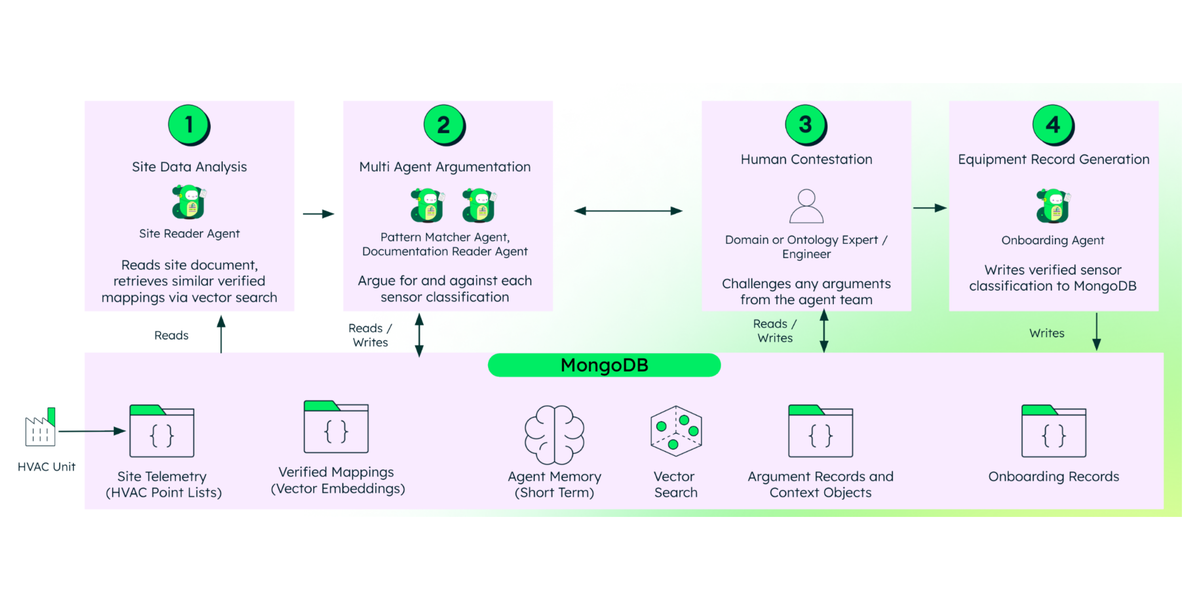
Akhtar and Freeman present contestable governance for industrial data, where specialist agents produce scored, cited arguments for disputed metadata decisions across structured records and unstructured documents. A human steward can accept, reject, modify or add arguments before commit, and a governance record retains the evidence, interventions and outcome. A versioned domain glossary supplies model-specific terms and acronym definitions to the agents, a triage path reserves full argumentation for uncertain proposals while preserving review before commit, and a gate controls which glossary versions agents may use.
Assessment
The design turns rubber-stamp approval into an auditable argument trail, a plausible template for human oversight of agent proposals at industrial scale.
October 22 preprint, announced October 23, two days before this report; catch-up coverage.
Listen
AI Post Transformers: a skeptical listen on sharing agent trajectories as collective memory
The hosts discuss Kim, He and colleagues' Multi-Agent Transactive Memory paper, in which agents dump raw task trajectories into one shared, searchable repository that frozen models retrieve from, with no joint training. The episode builds up from retrieval-augmented generation and single-agent experience memory (Reflexion, Synapse, ExpeL), questions the borrowed group-psychology framing (the system is closer to a Stack Overflow for agents than to a team, and trajectories were never written to be read), and examines the retrieval design, where the key is the task description plus the last five steps embedded with E5-Base and the value is the next five steps from a past run. It closes skeptically on the small, templated ALFWorld and WebArena testbeds and on the missing private-versus-shared memory control behind the paper's central claim.
Assessment
Useful scrutiny of what counts as collective memory: retrieval from a shared pool is not coordination, and the episode names the control experiment the claim needs.
Episode of October 23, two days before this report; catch-up coverage.
Editorial synthesis
Today's evaluation work measures what cooperation feels like from inside the conversation: whether an agent speaks at the right moment, and whether the transcript still means what the agents chose. The coordination results add the network back in, showing that who interacts with whom sets both the speed of agreement and the effort needed to break it.
Editorial interpretation of the cited sources.